
Witchcraft and spells have inspired cultures around the world for millennia. For the witch for beginners, the Craft may seem mysterious, but at its heart, it is simply a powerful collection of practices for working with nature’s energy. Historically, people have recorded witch spells from ancient incantations to medieval grimoires. Today’s witches and spells draw on these traditions to cast love spell witchcraft, protection jar spell magic, and simple daily witch rituals. This article introduces the core of witchcraft and spells, covering practical witchery spells and ethical guidelines.
At its core, all witchcraft is about intention. A beginner’s guide explains that a spell is simply the practice of using focused intention, energy, and symbolic tools to influence change. In other words, spells are structured ways to focus your will. A witchy spell might be as simple as lighting a red candle and speaking words of empowerment, or as complex as a full witchcraft ritual under the full moon. Today’s practitioners emphasize consent and ethical magic; even when doing a love spell witch working, the goal is to attract genuine, reciprocal feelings, not to control another person’s free will. Likewise, hexing spells (curses) are approached with caution because many traditions warn that the energy you send out “returns to you three times over.” Throughout this guide, we mix lore with practical tips so you can start your witch journey feeling empowered and informed.
Why the Witch Rises Today
Witchcraft is not a fantasy of folklore; it is a discipline of radical sovereignty and reclaimed power. To engage with the true nature of witchcraft and spells requires setting aside the caricature of broomsticks and recognizing the history of intentional energy work. The contemporary resurgence of the Craft is a powerful act of spiritual reclamation, transforming a weaponized historical epithet into a banner of deep expertise.
In nearly every culture worldwide, the figure of the witch or malicious mystical practitioner exists, fulfilling a persistent human need to explain profound misfortune. From the sorcerer casting learned witch spells to the figure with innate abilities, the reality is that witches and spells are a globally persistent phenomenon. However, the modern witch rejects this historical fear-based narrative, redefining witchcraft spells as the foundation of personal empowerment.
Today, modern practitioners actively identify as witches, defining witchcraft spells as a key part of their neopagan path since the 1930s. This is not merely a label; it’s a political and spiritual act, transforming a historical accusation into a banner of spiritual agency. For the witch for beginners embarking on this path, the goal is sovereignty, guiding their own reality through effective witchery spells. The following discourse establishes a framework for understanding the history of witchcraft and spells, detailing effective witch spells, and navigating the complex, yet necessary, ethical framework that guides a contemporary practitioner.
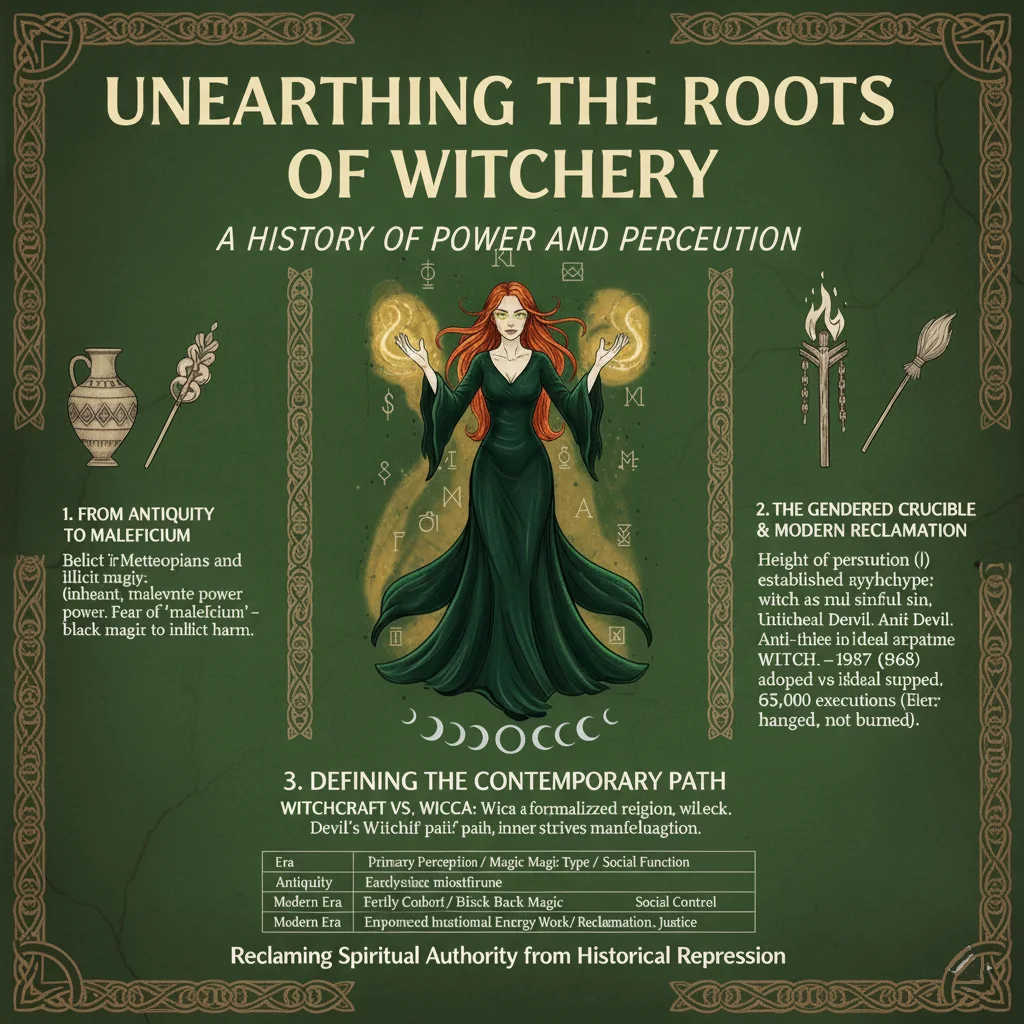
Unearthing the Roots of Witchery: A History of Power and Persecution
To engage in deep witchcraft rituals, one must first grapple with the millennia of tradition and cultural negotiation that define the path. The history of magic is complex, often raising more questions than it answers. 1. From Antiquity to Maleficium
The belief in malevolent magic is deeply rooted in human history, attested in ancient Mesopotamia and tracing back to classical antiquity in Europe. In Homer’s Odyssey (circa 800 BC), Circe, who transformed men into animals, was identified as a witch. Roman law also featured statutes against illicit magic, demonstrating that the need to control supernatural influence was a pervasive cultural concern.
A crucial historical distinction must be drawn between sorcery and witchcraft. Sorcery (or katares in ancient Greece) often required specialized skills, tools, and specific incantations, and its practice could sometimes be beneficial. Conversely, witchcraft was typically perceived as an inherent power drawn from malevolent forces and used for ill will against the community. In medieval and early modern Europe, the fear centered on maleficium—the secret use of black magic to inflict harm upon one’s own community.
2. The Gendered Crucible and Modern Reclamation
The height of persecution during the early modern period, particularly the 15th and 16th centuries, established the archetype of the witch as a woman full of sin. The Church played a central role, associating witches with the Devil and unspeakable acts, such as harming children and engaging in lurid sex. The witch became the antithesis of the expected ideal woman—obedient, diminished, and nurturing.
Historical research demonstrates that early accusations were not random. Witches were generally older women, often lacking robust social or family support networks, or possessing personality traits that caused community tensions. As the historian Christine Larner argued, women were not accused because they were women, but because they acted like witches—a crime that was sex-related, though not strictly sex-specific. This historical targeting shows that the fear of the witch often magnified the perceived threat of non-conformists and, in the absence of strong governance, helped enforce social norms and community cohesion.
The devastating Witch Trials, predominantly across Europe, resulted in an estimated 45,000 executions and 90,000 allegations. It is essential to correct common misconceptions; for instance, in England, witches were typically hanged, not burned. The modern movement reclaims this history of persecution. Second-wave feminist activists, such as the Women’s International Terrorist Conspiracy from Hell (WITCH) formed in 1968, adopted the term to create agency, community, and social justice through performative rituals. The contemporary practice is thus rooted in reclaiming spiritual authority from historical repression.
3. Defining the Contemporary Path: Witchcraft, Wicca, and Witchery Spells
For the witch for beginners, understanding the landscape of modern magic is vital. A key distinction must be drawn between Witchcraft and Wicca. Wicca is a formalized, modern pagan religion developed by Gerald Gardner in the 1940s and 50s, complete with specific beliefs, theology, and worship of gods and goddesses. While every Wiccan is considered a witch, not every witch is a Wiccan. Witchcraft, or the practice of witchery spells, is a broader path defined by the individual practitioner, often characterized as the path for the “renegade free spirit” within the wider spiritual community.
The effectiveness of a witchy spell in the modern context often relies on cultivating inner strength and belief. The instinct to believe—whether in science, lucky charms, or the Craft—is fundamentally part of human nature, and that focused belief is what drives manifestation.
The following table summarizes the key historical trajectory that led to the current understanding of witchcraft spells:
Historical Trajectory: The Evolution of the Witch Archetype
| Era | Primary Perception | Magic Type | Social Function |
| Antiquity (e.g., Classical Greece, Rome, Mesopotamia) | Malevolent/Ill-Willed Sorcerer (e.g., Circe) | Maleficium (Harmful magic) | Explaining localized misfortune; enforcing legal boundaries. |
| Early Modern Europe (15th–17th Centuries) | Devil’s Cohort/Anti-Woman Archetype | Black Magic (Associated with sin) | Social control; persecution of non-conformist women. |
| Modern Era (20th–21st Centuries) | Empowered Practitioner/Spiritual Sovereign | Intentional Energy Work (Eclectic) | Reclamation of agency; promoting feminist and social justice ideals. |
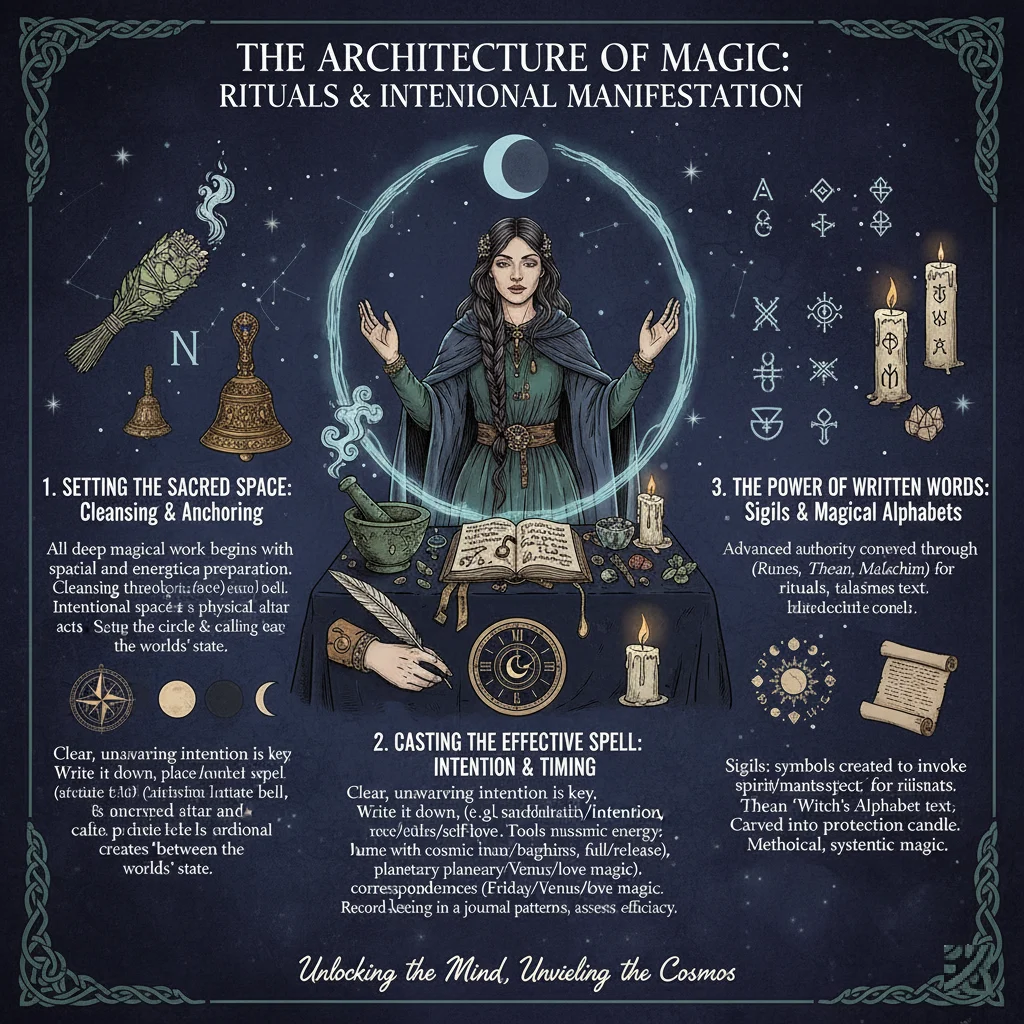
The Architecture of Magic: Rituals and Intentional Manifestation
Effective witch rituals are structured, intentional acts designed to harness and direct energy. This structure is critical because it provides a methodical, psychological framework for focusing the practitioner’s will, ensuring clarity and power in the working.
1. Setting the Sacred Space: Cleansing and Anchoring
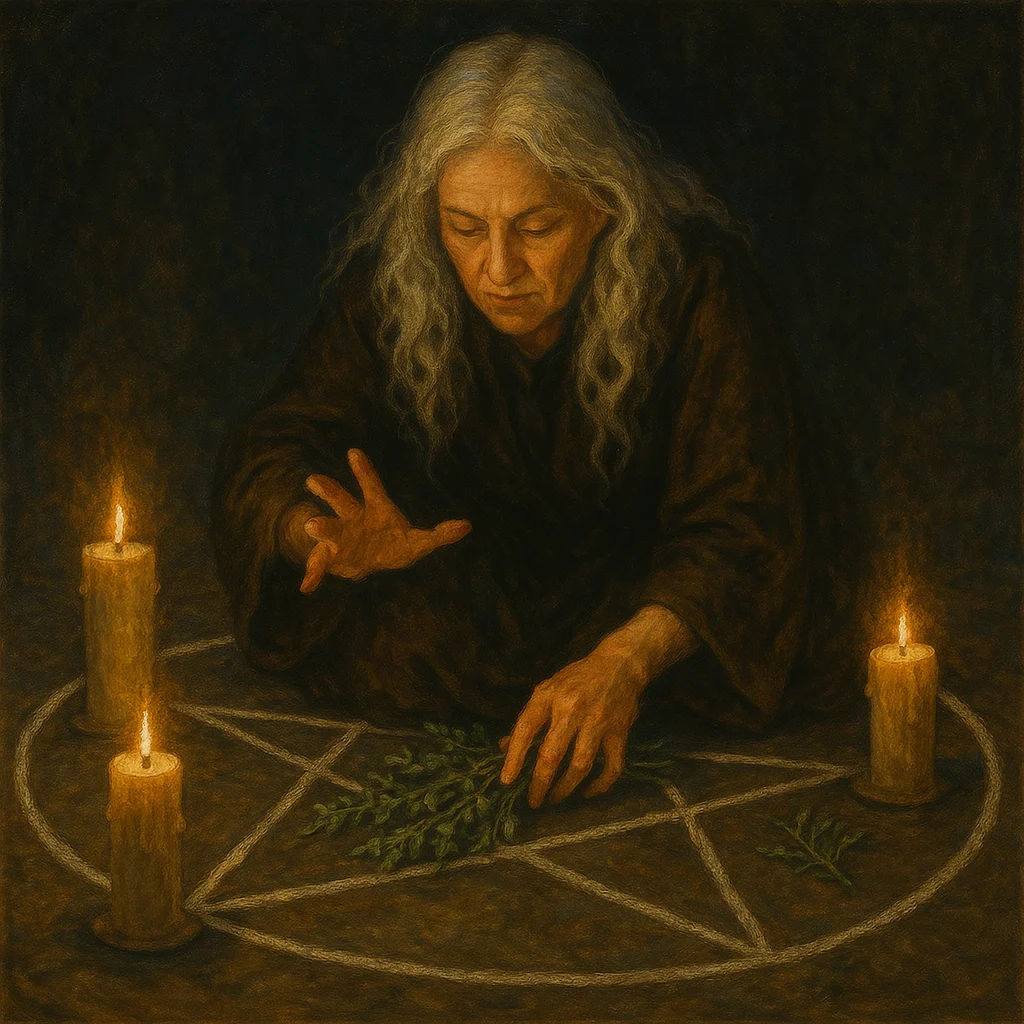
All deep magical work begins with spatial and energetic preparation. The primary goal is to cleanse the area and create a boundary between the mundane and the magical realm. Cleansing can be achieved through smoke from sage or incense, or through sound vibration from an altar bell. Once cleansed, practitioners often establish an intentional space or altar, which acts as a physical home and anchor for focused energy.
The ritual itself often involves setting the circle and calling the cardinal directions. This practice facilitates separating the participants from the everyday world, creating the necessary sacred state of being “between the worlds” where collaborative or personal magical work becomes possible.
2. Casting the Effective Spell: Intention and Timing
The power of any witch spell lies in clear, unwavering intention. Before gathering tools or lighting candles for witchcraft, the practitioner must pause and determine precisely what outcome they desire. This intention is often written down and placed within the spell itself to provide a physical focus.
Tools, whether simple household items or specialized objects, must be chosen carefully to match the intention (e.g., sandalwood for cleansing, rose for self-love). Furthermore, many experienced witches time their work to align with cosmic energy shifts. Examples include timing work based on the lunar phase (new moon for beginnings, full moon for release) or planetary correspondences (such as conducting love magic on a Friday, the day ruled by Venus).
For the witch for beginners, record-keeping is essential. Writing intentions and detailing ritual experiences in a journal helps track patterns, assess efficacy, and nurture the slow, organic growth of one’s personal practice. The power of magic is often found in the unfolding process, not in an instant wishing well.
3. The Power of Written Words: Sigils and Magical Alphabets
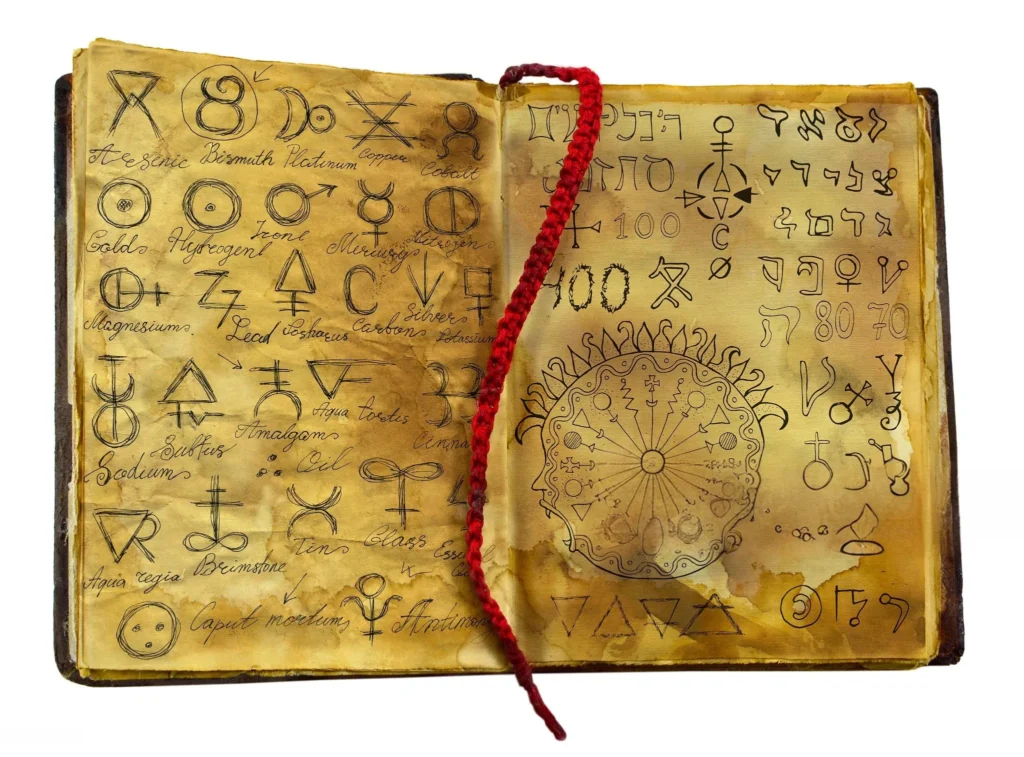
Advanced authority in occult practice is frequently conveyed through the use of coded letters and hidden knowledge. Magical alphabets, or magickal alphabets, are sets of letters used primarily in esoteric traditions for conducting witchcraft rituals, creating talismans, or casting spells. These include historical scripts such as Runes, the Theban alphabet (often called the ‘Witch’s Alphabet’), or those based on Hebrew ciphers (Malachim, Celestial). The Theban alphabet, for example, is used in modern practice for writing spells and inscriptions to disguise the text’s meaning and impart a mystical quality.
Distinct from these alphabets are sigils—symbols created by the practitioner to invoke a spirit or manifest a desired effect. Sigils are powerful tools for intention focusing and can be applied directly to spellwork, such as carving the sigil into a protection candle. These techniques underscore the intellectual rigor behind witch spells, demonstrating that effective magic is methodical and systematic, relying on an internal “economy of correspondence” to align symbols and intent.
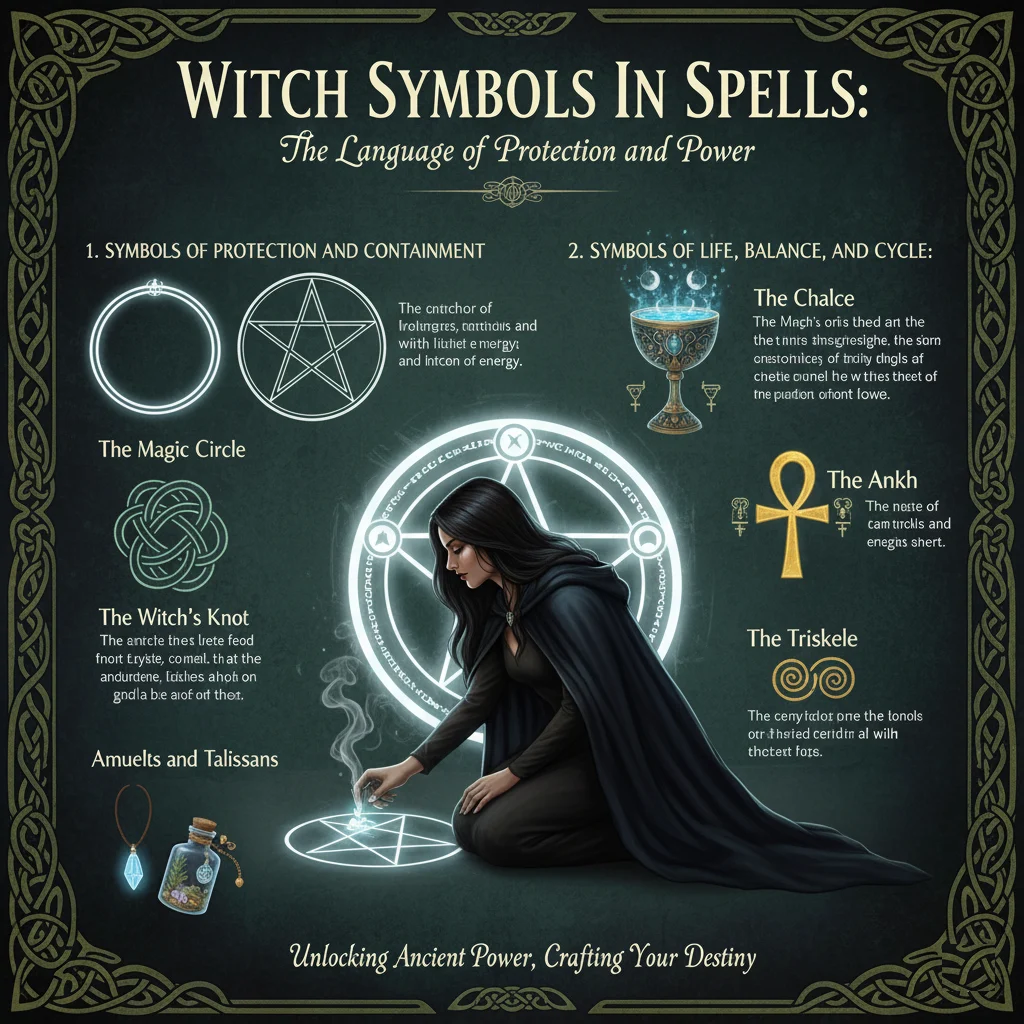
Witch Symbols in Spells: The Language of Protection and Power
Symbols serve as a language for the spiritual and unseen worlds, acting as visual tools that channel energy, intention, and meaning, thereby amplifying the power of witchcraft spells. Whether etched onto tools or visualized during a witch ritual, incorporating these symbols enhances the authority and focus of the work.
1. Symbols of Protection and Containment
The most crucial symbols for any practitioner relate to establishing safe boundaries and powerful protection:
- The Magic Circle: Often established as the first step in deep work, a magic circle is a physical or visualized energy field surrounding the practitioner. Its primary functions are twofold: to provide protection by intending that only positive energies may enter, and to contain and amplify personal energies, making the overall magic more potent.
- The Pentacle/Pentagram: This five-pointed star within a circle is a fundamental symbol of protection in modern witchcraft. It represents the five essential elements—Earth, Air, Fire, Water, and Spirit—signifying balance, unity, and life’s interconnectedness. The circle surrounding the points contains and protects the energy.
- The Witch’s Knot: Evolving from Celtic knotwork, this intricate, endless knot symbolizes protection and the powerful binding of energies. Its interwoven loops are seen as an unbreakable shield, often drawn on doors or windows for house protection or incorporated directly into charms.
- Amulets and Talismans: These are objects—such as crystals or personalized charms—ascribed specific magical powers and carried with the practitioner to draw energy from their set intentions. They are commonly included in charm bags and spell bottles.
2. Symbols of Life, Balance, and Cycle
Other core symbols communicate complex philosophical concepts central to witchery spells:
- The Chalice: Used in ceremonial drinking, the chalice typically represents the element of water on an altar. It is also a powerful symbol of femininity, fertility, and the bond between practitioners in a coven.
- The Ankh: Called the “key of life” in ancient Egypt, the Ankh’s loop symbolizes the union of opposites—masculine and feminine, life and death, physical and spiritual realms. It is used for renewal, balance, and aligning divine energies.
- The Triskele: Originating in Celtic traditions, this symbol of three connected spirals represents movement, life cycles, and the “power of three” (mind, body, and spirit). It is particularly effective when used in witch spells focused on transitions, such as new beginnings or embracing closure.
Tools of the Trade: Working with Flame, Earth, and Intent
This section provides practical applications of witchcraft spells using common, focused techniques, vital for the development of the witch for beginners.
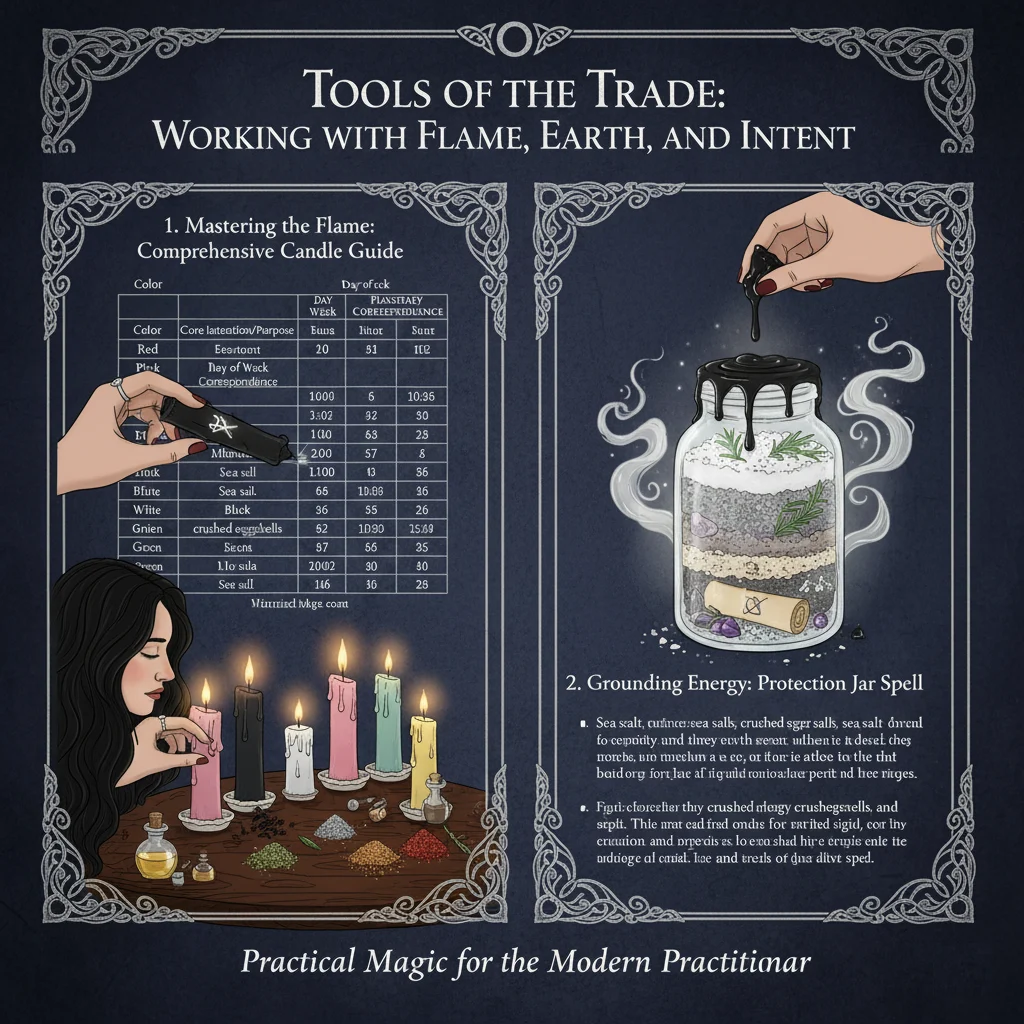
1. Mastering the Flame: A Comprehensive Guide to Candles for Witchcraft
Candles are foundational tools in witchy spell casting, serving as focal points to release energy through flame. The color of the candle is crucial, as each color corresponds to specific energies and intentions. Notably, a white candle can often be substituted for any other color, making it an excellent staple.
Effective candle work involves a process known as dressing and charging. For a taper candle, the practitioner must first cleanse the candle and then carve a sigil or phrase of intention onto its surface. Next, oil is applied—rubbed towards the practitioner to invite energy (e.g., money, love), or rubbed away from the practitioner to repel negative energies. Finally, the candle is coated in corresponding herbs and spices before being lit while focusing the intention.
The authority of the practice is enhanced by using planetary correspondences for ritual timing:
Candle Color Correspondences and Timing
| Color | Core Intention/Purpose | Day of Week | Planetary Correspondence |
| Black | Protection, Repelling, Banishing, Absorbing Negativity | Saturday | Saturn |
| White | Cleansing, Truth, Wisdom, Goddess/Lunar connection | Monday | The Moon |
| Red | Passion, Strength, Fast-Acting Spells, Love, Friendship | Tuesday | Mars |
| Pink | Unconditional Love, Self-Love, Romance, Affection | Friday | Venus |
| Yellow | Success, Intuition, Communication, Joy, Confidence | Wednesday | Mercury |
| Blue | Spiritual/Emotional Healing, Creativity, Communication | Thursday | Jupiter |
2. Grounding Energy: The Protection Jar Spell
The protection jar spell is a foundational witch spell designed to capture negative energy and ward off danger from a specific space or person. This ritual work emphasizes self-sovereignty and boundary setting, mirroring the modern witch’s focus on defining her own energetic space.
Step-by-Step Construction of a Protection Jar:
- Cleanse the Vessel: Begin by cleansing a medium-sized glass jar using incense or sage smoke, or by soaking it in a sea salt solution.
- Layer the Foundation: Add a foundational layer of sea salt or black salt to absorb negativity.
- Add Protective Ingredients: Include herbs and spices known for warding off harm, such as cloves (also used for banishment), sage, rosemary, and cinnamon. A particularly authoritative ingredient is crushed eggshells, which apply the concept of sympathetic magic: just as the shell protects a developing life, it wards off malicious spirits and intent.
- Seal the Intention: Place protective crystals and a written personal intention, sigil, or phrase (e.g., “This place is protected”) inside the jar.
- Charge and Seal: Hold the jar, focus on the intention, and chant a protection incantation, such as “I am protected and safe”. Seal the jar tightly with its lid, and then melt wax from a black or white candle over the seal.
- Placement and Maintenance: Place the jar where protective energy is most needed, such as near the front door to ward off negativity, on an altar, or concealed in a closet. It is recommended to cleanse the jar monthly under the full moon to maintain its potency, as trapped negative energy can clog its purifying abilities.
The Ethical Crucible: Navigating Love, Laughter, and the Law of Three
Demonstrating expertise in modern witchcraft requires a deep understanding of ethics, particularly concerning the use of power against others.
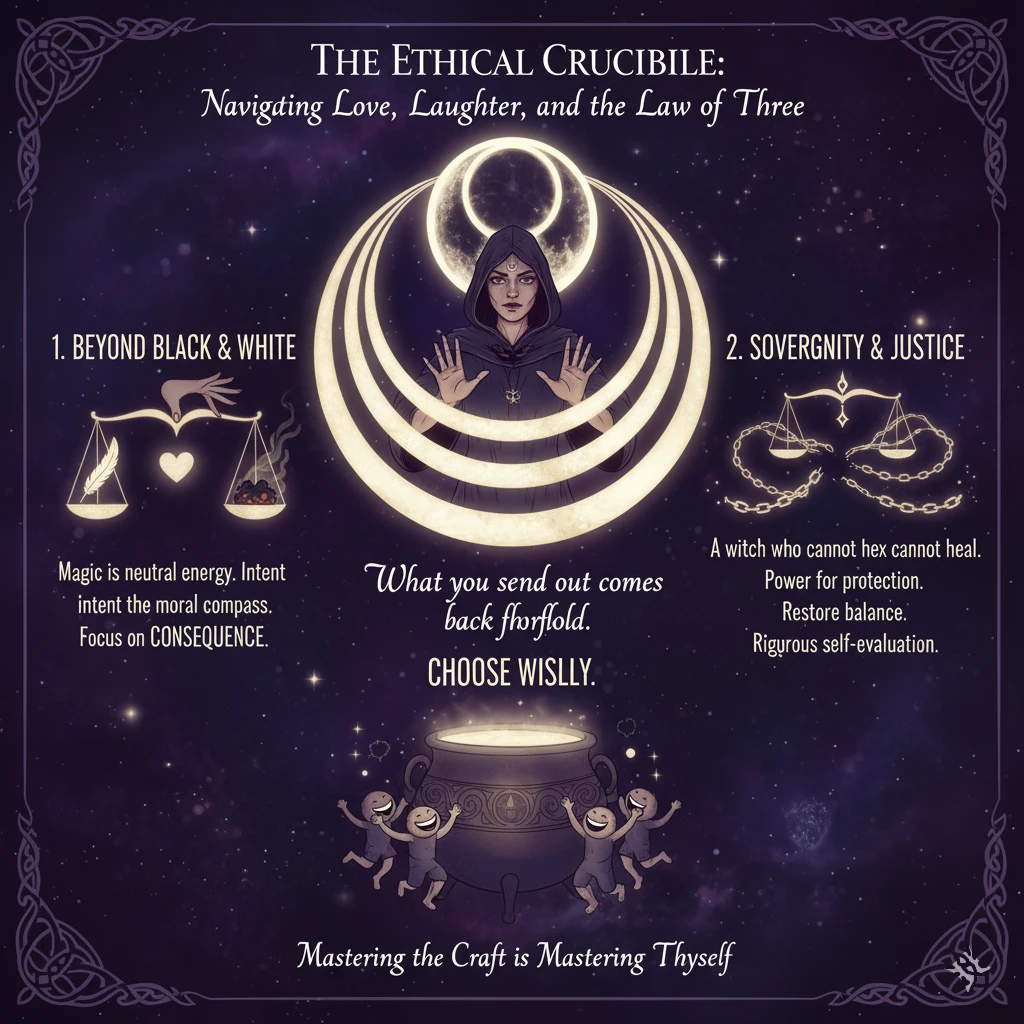
1. The Ethical Witch: Beyond Black and White Magick
A critical misconception in the mainstream view of witchcraft and spells is the belief in rigid “White Magick (Good)” versus “Black Magick (Evil)” categories. Expert practitioners assert that this dichotomy is a fallacy. Magic is energy, and energy is inherently neutral. The moral coloring of any witchy spell is determined solely by the intent of the caster and the consequence of the working. An ethical practice demands that the practitioner takes full responsibility for the outcomes they initiate, particularly when dealing with baneful magic.
2. Understanding the Rule of Return
The need for strict ethical self-governance in magical practice is often encapsulated by the Rule of Three, also known as the Three-fold Law or the Law of Return. This is a foundational religious tenet held by many Wiccans, Neo-Pagans, and occultists. The Law posits that whatever energy a practitioner puts out, particularly when working magic, will return to them three times intensified—be it reward or punishment.
Although sometimes loosely compared to the concept of karma, the Rule of Three acts as a profound ethical deterrent. It ensures that experienced witches understand that casting negativity toward another is energetically unsustainable, as the backlash would be immense. Historically, belief in witchcraft served to maintain order in the absence of effective governance ; today, the Rule of Three serves as an internal, self-imposed ethical mechanism that validates the trustworthiness of the modern practitioner to society, preventing a return to the historical archetype of the feared, antisocial malfeasor.
3. Hexing Spells: Sovereignty, Justice, and Caution
Hexing spells and baneful magic are among the most contentious subjects within the Craft. Authoritative dialogue demands moving beyond simple prohibitions. While sweeping declarations like “No one should ever hex or curse” exist, they often lead to unnecessary gatekeeping and fail to address complex issues of morality.
A nuanced perspective acknowledges that power must be used for justice and self-defense. This is reflected in the advanced philosophical assertion, “A witch who cannot hex cannot heal”. This position suggests that true magical competence includes the ability to use necessary energetic force for protection and to restore balance when severe injustice or oppression is present.
However, due to the principle of return (the Rule of Three), engaging in hexing spells is viewed as advanced practice requiring rigorous ethical self-evaluation. The practitioner must meticulously evaluate their morality and intent, ensuring that the working is for true justice and not mere retribution or fleeting anger. The decision to use baneful magic must be the result of deep inquiry into the ethics of the situation, recognizing the heavy consequences associated with the intentional direction of negative energy.
Love Spell Witchcraft: Attraction, Free Will, and Manifestation
Among all magical workings, love spell witchcraft consistently garners the highest demand, dating back to medieval grimoires. However, this field is also the most ethically fraught, demanding clarity on the principle of consent.
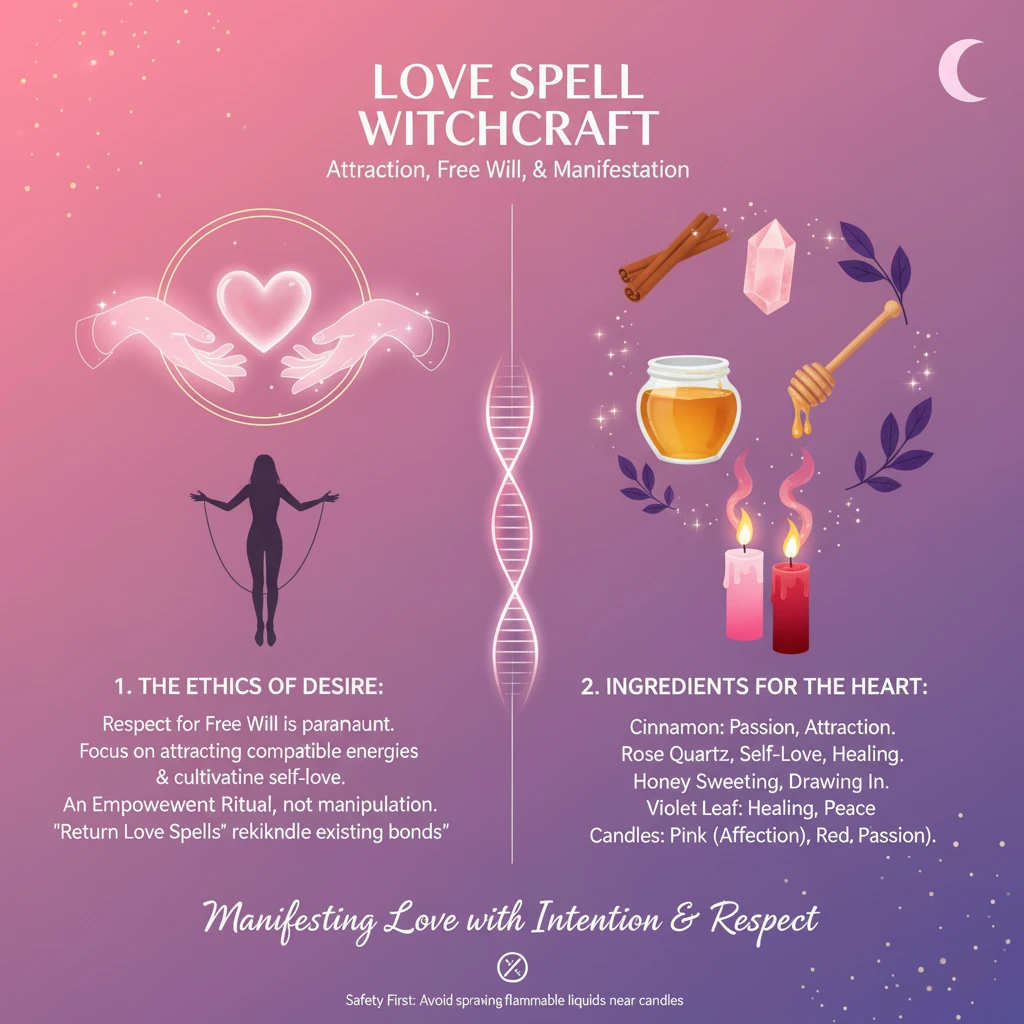
1. The Ethics of Desire: Free Will and Love Spell Witch
The highest ethical barrier in any love spell witch work is the respect for free will. Ethical practitioners refuse to cast any witch spell designed to compel a specific individual to feel affection, as this constitutes energetic manipulation and violates consent. While some believe that a compelled love spell is trivial because it cannot force love, the intent to violate free will is ethically significant.
The acceptable practice focuses instead on attraction and empowerment. Ethical love spell witchcraft aims to cultivate the love the practitioner craves by raising their personal vibration, attracting compatible energies, strengthening existing healthy relationships, or focusing on self-love. For instance, a return love spell aims to rekindle existing passion when a companion is becoming aloof, rather than forcing a new connection. The most powerful ethical spell is, therefore, an empowerment ritual, turning a focus of external desperation inward to cultivate self-sovereignty.
2. Ingredients for the Heart: Practical, Ethical Magic
Effective love magic does not require rare components; rather, the most potent workings often utilize budget-friendly, common household ingredients that carry the practitioner’s personalized energy.
- Cinnamon Sticks: Known as a fiery spice, cinnamon is excellent for attraction, passion, and quickening spell release when burned with a red candle.
- Rose Quartz: This crystal is commonly used for nurturing self-love, healing the heart, and focusing romantic intention.
- Honey: Used in spells for “sweetening” relationships or drawing in gentle energy.
- Violet Leaf: Used for healing a broken heart, promoting peace, and attracting prophetic dreams concerning a future partner.
- Candlework: Pink candles are ideal for unconditional love and affection, while red candles invoke fast-acting passion.
As an authoritative source, it is mandatory to include safety precautions when handling ingredients and performing rituals. Practitioners must avoid spraying flammable items near open flames, store materials away from heat, and ensure proper ventilation, adhering to safe handling practices.
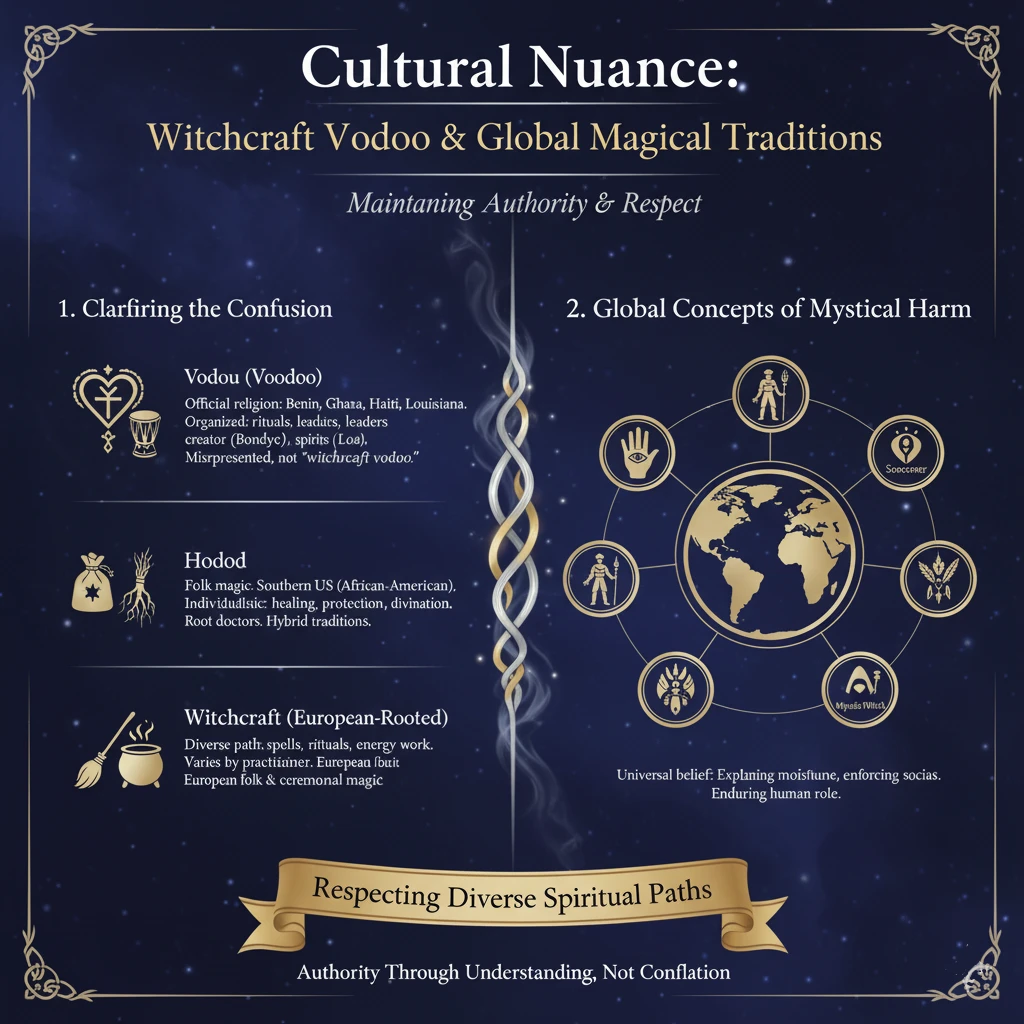
Cultural Nuance: Witchcraft Voodoo and Global Magical Traditions
Maintaining authority requires cultural respect and accurate delineation of global magical systems. The term witchcraft voodoo is often used mistakenly to conflate distinct spiritual traditions.
1. Clarifying the Confusion: Vodou, Hoodoo, and Witchcraft Voodoo
It is vital to distinguish between Vodou, Hoodoo, and European-rooted witchcraft traditions.
- Vodou (Voodoo): Vodou (also spelled Vodun or Vodou) is an official religion originating from traditional African religions of the Fon and Ewe people (in modern Benin and Ghana). It evolved into Haitian Vodou and Louisiana Vodou. It is an organized religion with rituals, leaders, and a defined belief system, including an omnipotent creator (Bondye) and subordinate spirits (Loa) who interact with humans. The common cultural association of witchcraft voodoo is often a result of historical misrepresentation, commodification, and racial anxieties, leading to the false perception of Vodou as merely an exotic, malefic form of witchcraft.
- Hoodoo: Hoodoo is not a religion, but rather a system of African-American folk magic practices developed primarily in the Southern United States. It is individualistic and focuses on practical applications such as healing, protection, and divination. Hoodoo practitioners, sometimes called root doctors or root healers, draw on a hybrid of West African folk traditions, Native American practices, and European magick.
An authoritative source recognizes these are distinct spiritual streams. While the practices of witchcraft voodoo and other forms of witchery spells share the superficial element of using magic, they operate under different theological and cultural frameworks. Understanding this context validates that the figure of the witch, whether known as a sorcerer, a root doctor, or a modern practitioner of witchcraft rituals, fulfills an enduring human role.
2. Global Concepts of Mystical Harm
The diversity of global magical practice highlights a unifying theme: the cross-cultural existence of mystical harm practitioners. Anthropological analysis confirms that various conceptions of malicious figures—including sorcerers who use learned spells, possessors of the evil eye, and witches—recur across the world. This universality demonstrates that belief in magic plays a vital role in cultural selection, providing intuitive frameworks for explaining misfortune and justifying societal responses. Understanding this context validates that the figure of the witch, whether known as a sorcerer, a root doctor, or a modern practitioner of witchcraft rituals, fulfills an enduring human role.
Conclusion: The Enduring Power of the Witch
The comprehensive study of witchcraft and spells reveals a practice steeped in complex history and defined by sophisticated, ethical application. The modern path is a powerful movement of reclaiming spiritual authority, transforming a historical epithet of persecution into a title of sovereignty.
For the witch for beginners, the most critical advice is to build a practice slowly and organically. Starting small—tracking the moon, keeping a journal, or attempting a simple, focused witch ritual—allows the magic to unfold naturally. Intuition must be followed above all else, as the practice is deeply personal and lacks a central authority figure.
Ultimately, the power of witch spells lies not in coercing fate or violating the free will of others, but in the rigorous cultivation of intentionality and self-sovereignty. By adhering to a strong ethical framework, understanding the historical weight of the craft, and mastering foundational witch rituals like the protection jar spell and working with candles for witchcraft, the modern practitioner establishes themselves as an authoritative, deliberate force in their own life. The journey into witchery spells is one of continuous learning, structure, and focused belief.
Power of the Witch Spells
Witchcraft has been practiced for centuries, harnessing the power of nature, intention, and ritual to manifest desires and bring about change. Whether you are a seasoned practitioner or a beginner, understanding witch spells and their significance is essential to your magical journey.
In this guide, we will explore witchcraft spells, their history, and how to use them effectively. You’ll find a witch spells list, beginner-friendly spells, ancient spells, and even spells for kids. Whether you’re looking for real witch spells or a witch spells PDF to download, this guide has everything you need to dive into the world of magic.
The Power of Witchcraft Spells
Witchcraft and spellcasting have captivated imaginations for centuries. While often shrouded in mystery and sometimes misinformation, witch spells represent a practice with diverse traditions and purposes. This article explores the world of witch spells, answering common questions and providing examples.
What Kinds of Spells Do Witches Do?
Witches perform a wide variety of spells, reflecting the diverse needs and desires of humanity. These can include:
- Healing spells: To promote physical, emotional, or spiritual well-being.
- Protection spells: To ward off negative energies, entities, or harm.
- Love spells: To attract love, strengthen relationships, or promote self-love.
- Prosperity spells: To attract wealth, abundance, or success.
- Divination spells: To gain insight into the future or hidden knowledge.
- Banishing spells: To remove unwanted influences, habits, or entities.
The intent behind the spell is crucial, and ethical considerations often guide a witch’s practice.
What are the 7 Types of Spells?
While categorization can vary, a common way to classify spells includes these types:
- Healing Spells: Focused on restoring health and balance.
- Protection Spells: Designed to create a shield against negativity.
- Love Spells: Aimed at matters of the heart, from self-love to attracting a partner.
- Prosperity Spells: Intended to increase wealth, success, and abundance.
- Banishing Spells: Used to remove unwanted energies, habits, or entities.
- Divination Spells: Employed to seek knowledge or guidance.
- Curse/Hex Removal Spells: Designed to break negative spells or energies.
It’s important to note that many witches avoid performing curses or hexes, focusing instead on positive magic.
What is the Witch Language?
There isn’t one universal “witch language.” Witches have historically used various languages and methods, including:
- Traditional languages: Some spells are passed down in languages like Latin, Greek, or Old English.
- Personal languages: Some witches incorporate their own words, chants, or intentions into their spells.
- Symbolism: Symbols, sigils, and gestures are often used as a form of nonverbal “language” in spellcasting.
What are Examples of Magic Spells?
Examples of witch spells are vast and varied. Here are a few:
- A candle spell for protection, where a black candle is inscribed with protective symbols and burned.
- A herbal sachet spell for attracting love, where specific herbs are combined in a sachet and carried.
- A meditation spell for healing, where visualization and focused intention are used to promote well-being.
What is the Most Famous Magic Word?
While there isn’t one universally recognized “most famous” magic word, some popular examples include:
- Abracadabra: An ancient word with debated origins, often used in stage magic.
- Alakazam: Another word commonly used by stage magicians.
In witchcraft, the witch’s intention and focus are often considered more important than any specific word.
What are Healing Spells?
Healing spells are a core aspect of many witchcraft practices. These spells aim to promote well-being on physical, emotional, and spiritual levels. They can involve:
- Herbal remedies: Using herbs for their healing properties.
- Energy work: Directing energy to promote healing.
- Visualization: Using mental imagery to aid in the healing process.
- Chants and affirmations: Using words and sounds to focus intention.
How to Make a Love Spell?
Witch spells for love vary widely. A basic love spell might involve:
- Candles: Using pink or red candles to represent love and passion.
- Herbs: Incorporating herbs like rose, lavender, or cinnamon.
- Crystals: Using crystals like rose quartz to enhance loving energy.
- Intention: Clearly defining the desired outcome, such as attracting self-love or strengthening a relationship.
- Ethical considerations: Most witches emphasize that love spells should never be used to manipulate or control another person.
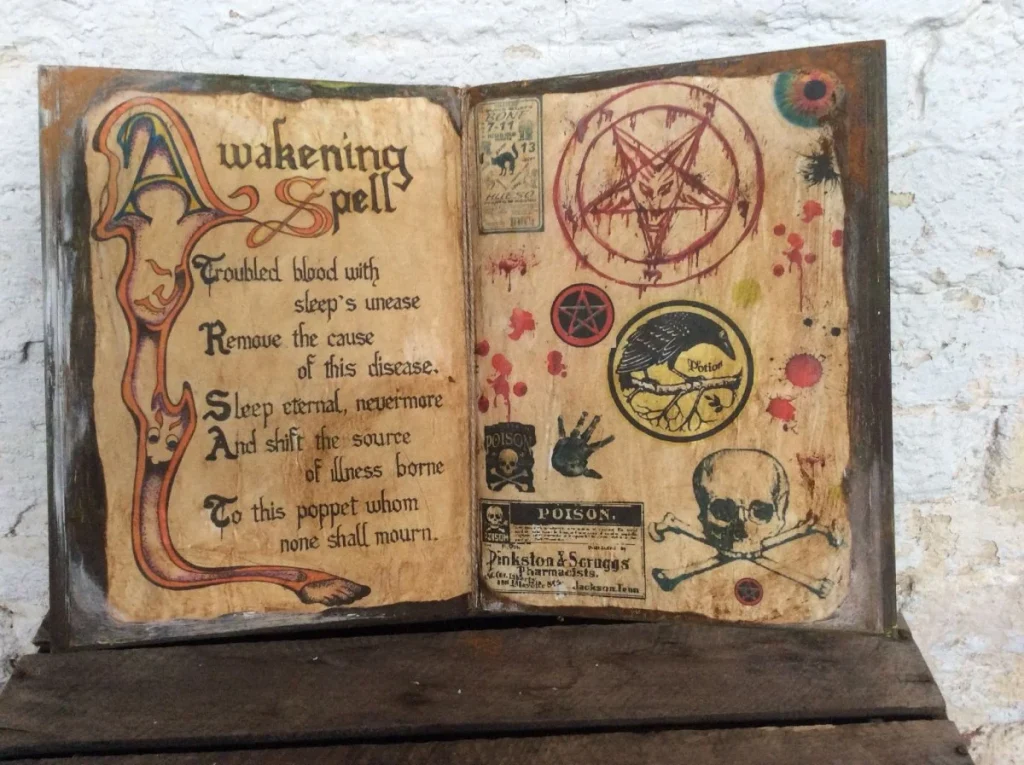
What is a Witch’s Book Called?
A witch’s book is often called a:
- Book of Shadows: A personal journal of spells, rituals, and magical knowledge.
- Grimoire: A textbook of magic, often containing more complex spells and instructions.
What are Divine Spells?
The term “divine spells” can have different meanings. In some contexts, it might refer to:
- Spells that invoke or work with deities or divine energies.
- Spells that are considered particularly powerful or blessed.
In some role-playing games, “divine spells” are contrasted with “arcane spells”.
Witch Spells That Work
The effectiveness of witch spells is a matter of personal belief and experience. Many practitioners believe that spells work through a combination of:
- Intention: The focus and energy the witch puts into the spell.
- Energy: The manipulation of subtle energies.
- Symbolism: The use of objects, words, and actions that hold symbolic meaning.
- Belief: The witch’s belief in the power of the spell.
Witch Spells for Beginners
For those new to spellcasting, it’s often recommended to start with simple witch spells. These might involve:
- Candle magic: Using candles of different colors to represent different intentions.
- Herbal sachets: Combining herbs with specific properties in a small bag.
- Simple chants or affirmations: Repeating words or phrases to focus energy.
It’s important for witch spells for beginners to focus on clear intentions and ethical practices.
Witch Spells For Kids
When introducing children to the concept of witch spells, it’s crucial to emphasize:
- Safety**: Using only safe materials and practices.
- Positive intentions**: Focusing on spells for good purposes, like kindness, gratitude, or creativity.
- Simplicity**: Keeping spells very simple and easy to understand.
Examples of witch spells for kids might include creating a “happy jar” filled with positive affirmations or making a simple charm for good dreams.
Ancient Witch Spells List
Ancient witch spells list can be found in various historical texts and traditions. Some examples include:
- Egyptian magic: Spells for healing, protection, and passage into the afterlife.
- Greek magic: Spells involving deities, herbs, and rituals for various purposes.
- Norse magic (Seidr): Spells and rituals for divination, healing, and influencing fate.
Many modern witch spells draw inspiration from these ancient witch spells list and practices.
List of Spells
A list of spells can be organized in many ways, such as by:
- Purpose (e.g., love spells, healing spells)
- Ingredients (e.g., candle spells, herbal spells)
- Tradition (e.g., Wiccan spells, Celtic spells)
5 Witch Spells with Examples
Here are 5 witch spells, with details on their purpose, ingredients, and procedure:
1. Protection Candle Spell
- Purpose: To create a protective barrier around yourself or your home.
- Ingredients:
- 1 black candle
- A fire-safe dish or candle holder
- Protection oil (e.g., rosemary, frankincense)
- A sharp tool (e.g., athame, knife)
- Procedure:
- Cleanse the candle and dish.
- Anoint the candle with the protection oil, moving from the top down.
- Carve a symbol of protection (e.g., a pentagram, a circle) into the candle.
- Place the candle in the dish.
- Light the candle and say an incantation such as, “By the power of this flame, I am protected from all harm. Negative energies have no power over me.”
- Allow the candle to burn completely (if safe) or extinguish it and save it for later use.
2. Herbal Sachet for Peaceful Sleep
- Purpose: To promote restful sleep and ward off nightmares.
- Ingredients:
- A small cloth bag (e.g., muslin, cotton)
- Dried lavender
- Dried chamomile
- Dried mugwort
- Procedure:
- Combine the dried herbs in a small bowl.
- While combining the herbs, focus on your intention for peaceful sleep.
- Place the herbs in the cloth bag and tie it closed.
- Place the sachet under your pillow or near your bed while you sleep.
3. Gratitude Jar Spell
- Purpose: To cultivate gratitude and attract positive energy.
- Ingredients:
- A jar
- Small pieces of paper
- A pen or marker
- Optional: crystals, herbs, or other items that represent gratitude
- Procedure:
- Cleanse the jar and any other items you will be using.
- Each day, write down something you are grateful for on a small piece of paper.
- Fold the paper and place it in the jar.
- You can add crystals, herbs, or other items to the jar to enhance its energy.
- As you add each piece of paper, express your gratitude.
- Periodically, you can empty the jar and read the notes to remind yourself of the good things in your life.
4. Money Spell
- Purpose: To attract financial abundance.
- Ingredients:
- A green candle
- A fire-safe dish
- A coin (any denomination)
- Cinnamon
- A carrier oil (olive oil, sunflower oil)
- Procedure
- Cleanse the candle, dish, and coin.
- Anoint the candle with the carrier oil, pulling the oil towards you.
- Sprinkle cinnamon on the candle.
- Place the candle in the dish and the coin in front of it.
- Light the candle and say an incantation, such as “Money come to me, abundance set me free, with harm to none, this spell is done”.
- Let the candle burn completely. Carry the coin with you, or place it somewhere you keep your money.
5. Self-Love Ritual Bath Spell
Soak in the bath for at least 20 minutes, focusing on feelings of self-love and acceptance.
Purpose: To promote self-love and acceptance.
Ingredients:
- Bathwater
- Rose petals
- Rose essential oil or rosewater
- Pink Himalayan salt
- Rose quartz crystal
- Candles
Procedure:
- Cleanse the bathroom and prepare a bath with warm water.
- Add rose petals, rose essential oil/rosewater, and pink salt to the water.
- Place the rose quartz crystal near the tub.
- Light the candles in the bathroom.
- Enter the bath and relax.
- Hold the rose quartz crystal and visualize yourself surrounded by loving, pink light.
- Say affirmations of self-love, such as “I love and accept myself unconditionally,” or “I am worthy of love and happiness.”
Frequently Asked Questions (People Also Ask)
How do witch spells work?
Witch spells work by focusing energy and intention through rituals, symbols, and materials such as herbs, candles, and crystals. The key is to align your thoughts and desires with universal energy to bring about the desired outcome.
What are the most powerful witchcraft spells?
The most powerful spells include protection spells, love spells, and manifestation spells. Ancient spells that incorporate runes, moon phases, and elemental magic tend to be especially effective.
Where can I find a list of witchcraft spells?
A comprehensive witch spell list can be found in books, online resources, and witch spells PDFs. Many witch spells websites also provide curated lists of effective spells.
Are witch spells real?
Yes, real witch spells exist and are practiced by many people worldwide. Their effectiveness depends on the practitioner’s belief, focus, and skill in harnessing energy.
Can kids do witch spells?
Yes, there are simple and safe witch spells for kids, such as wishing spells, dream spells, and nature spells. These spells help children connect with nature and their inner power.
Do I need special tools to cast a spell?
Not necessarily. While tools like candles, herbs, and crystals can enhance spells, the most important aspect of spellcasting is intention and focus.
Where can I download a witch spells PDF?
Many online witch spells websites offer free or paid witch spells PDFs containing detailed spell lists and rituals for different purposes.
By using this guide and exploring various witchcraft spells, you can unlock your potential and embrace the mystical world of magic. Let the magic flow and manifest your desires!
Spells have been a part of human culture for centuries, with roots in ancient religions and practices. From witches casting spells in medieval times to modern-day Wiccans performing rituals, the use of spells is a way for individuals to tap into a deeper power and bring about desired changes in their lives.
What is the meaning of Spells in Magic?
The spell can be briefly defined as the belief that nature may be affected by using supernatural powers. the other deep meaning of An incantation, a spell, a charm, an enchantment, or a bewitching is a form of ritualized magic symbols used to focus and direct energy to achieve a desired result. They are typically performed with the help of special tools and ingredients, such as candles, herbs, oils, and crystals. Spells can be used to bring about positive changes in one’s life, such as attracting love, money, health, or success.
They can also be used to ward off negative energy or protect against harm. The formula can be spoken, sung, or chanted. An incantation can also be performed during ceremonial rituals or prayers.
What language are spells in?
The language in which spells are cast can vary widely depending on the tradition, culture, and individual practitioner. There is no one specific language that all spells are cast in. The choice of language for a spell can depend on several factors.
The language of spells is sometimes archaic and is not always understood by the reciter. In some cases, meaningless but familiar terms are believed to be efficacious because of their traditional value. Much magical language, however, is clearly and directly correlated with the aim of the recital. In a symbolic statement by analogy it represents and foreshadows the technical achievement, and metaphor and simile are freely used. An example is a Maori spell giving speed and grace to a canoe, which speaks of the swiftness of a bird on the wing and the lightness of a seagull and which uses such onomatopoeic effects as speed noises or the wailing of the sea.
What is to cast a spell?
To cast a spell is to perform a ritual or use specific words, gestures, and sometimes physical objects or ingredients in an attempt to influence the outcome of a situation or to bring about a desired change through supernatural or metaphysical means. Spellcasting is often associated with various forms of magic, witchcraft, and occult practices, and it has been a part of human culture and folklore for centuries.
The process of casting a spell typically involves several key elements:
- Intention: The caster must have a clear and specific intention for what they want to achieve with the spell. This could be anything from protection and healing to love and prosperity.
- Components: Spells often involve the use of specific tools, ingredients, or props, such as candles, herbs, crystals, symbols, or written incantations. These items are believed to enhance the effectiveness of the spell.
- Words or Chants: Incantations or spoken words, often in the form of chants or rhymes, are used to focus the caster’s intent and energy. These words may be spoken or chanted during the ritual.
- Gestures and Symbols: Hand gestures, symbols, or specific movements may be part of the spellcasting process. These actions are believed to channel the caster’s energy and intention.
- Visualization: The caster often visualizes the desired outcome of the spell, concentrating their thoughts and energy on the goal.
- Energy Manipulation: Many spellcasters believe they are tapping into and manipulating natural or supernatural energies to bring about their desired result.
- Timing: Some spells are performed during specific times, such as certain phases of the moon, particular days of the week, or specific astrological events, to enhance their effectiveness.
The History of Spells
Spells are a form of magic that has been used since ancient times. They are used to invoke certain energies, to bring about desired changes in a person’s life, and to protect against harm. Spells can be found in many cultures, from ancient Egypt to the present day.
The earliest recorded use of spells dates back to ancient civilizations, such as the Egyptians and Greeks. These early spells were often used for practical purposes, such as ensuring a good harvest or protecting against illness. As civilizations developed, so too did the use of spells, with religious and spiritual beliefs becoming intertwined with their practice. Spells were used to bring good fortune, ward off evil spirits, and heal the sick. The Egyptians believed that spells had the power to alter fate and that the gods could be called upon to grant wishes. Spells were often written on papyrus scrolls or inscribed on tombs.
In ancient Greece, spells were used to cure illness, protect from danger as using white magic, and ensure success in business. Spells were also used to bring good luck and to ward off evil spirits. The Greeks wrote many spells on scrolls, which were often placed in temples or tombs.
During the Middle Ages, the use of spells became associated with witchcraft and magic. Those who were accused of practising witchcraft were often persecuted and even executed. Despite this, the practice of spells and witchcraft continued, with secret societies and covens forming to keep the tradition alive.
In the Renaissance period, spells were used for a variety of purposes. Spells were used to finding love, to bring wealth, and to protect against danger. Spells were often written on parchment or inscribed on stones or other objects.
In the modern age, spells are still used for a variety of purposes. People use spells to bring good luck, to protect against harm, and to bring about desired changes in their lives. Spells are often written on parchment or inscribed on stones or other objects.
Types of Spells
There are many different types of spells to cast, each with its own unique properties and effects.
Protection Spells
Protection spells are used to ward off negative energy, protect against physical or emotional harm, and guard against curses or hexes. These spells may involve the use of crystals, herbs, and other magical items to create a shield of protection around the person or place being protected.
Healing Spells
Healing spells are used to bring physical, emotional, and spiritual healing to an individual. These spells may involve the use of herbs, crystals, and other magical items to help restore balance and harmony to the body and mind.
Love Spells
spells for love are used to attract love, increase passion, and strengthen existing relationships. These spells may involve the use of candles, Herbs for Love Spells, and other magical items to help bring love into the life of the practitioner.
Prosperity spells
Prosperity spells are used to bring abundance, wealth, and success into the life of the practitioner. These spells may involve the use of crystals, herbs, and other magical items to help manifest the practitioner’s desired outcome and most of all the money spells.
Black spells
Black spells, or dark magic, counter spells are a type of spell that is used for malicious purposes, often to bring harm or misfortune to others. It is often associated with the forces of evil, such as demons, witches, and other dark entities. Black magic is also known as dark magic and is used to manipulate and control people, to cause harm, and to bring pain and suffering. It is believed to be derived from ancient rituals and practices that were used to summon dark forces and to manipulate the will of another person. Black magic is often used to bring about negative outcomes and can be used for a variety of purposes, including revenge, manipulation, and control.
Dream Spells
Dream spells are used to help bring clarity and insight into the practitioner’s life. These spells may involve the use of
How To Use Spells
To begin, you must first understand the basics of spellcasting. Spell casting is the process of using magical words and witch symbols to create a desired effect. Spells can be cast in a variety of ways, including through verbal chants, writing, drawing, or using other objects. It is important to understand the basics of spell casting before attempting to cast a spell.
To cast a witch spell, the practitioner will typically begin by cleansing the space. This can be done with the burning of incense or sage, or by using a ritual bath. Once the space is cleansed, the practitioner will then gather the ingredients and tools needed for the spell. This could include candles, herbs, oils, and crystals.
Once you have a basic understanding of spell casting, you will need to choose the type of spell you want to cast. Different types of spells can be used for different purposes. For example, a love spell can be used to attract a new romantic partner, while a protection spell can be used to guard against negative energy. It is important to research each type of spell before attempting to cast it, as some spells can be dangerous if not done correctly.
Once you have chosen the type of spell you want to cast, you will need to gather the necessary materials. Depending on the type of spell, you may need to collect items such as herbs, candles, stones, or other objects. You may also need to create a ritual space, such as a circle of stones or a special altar.
Once you have gathered the necessary materials, you are ready to begin the spell. Start by focusing on your intention and visualize the desired outcome. Speak the words of the spell aloud, or write them down if you prefer.
Real Spells of Magic
The Spell of the Three Wishes: This ancient spell is said to grant the caster three wishes. It was used by the legendary magician Merlin and is believed to be the source of the popular fairy tale “The Three Wishes”. To cast the spell, the caster must stand in a circle of nine candles, light them, and recite the following incantation: “Three wishes I have, three wishes I crave, in the name of the gods, I ask these three be granted.”
The Spell of the Flying Carpet: This spell is said to allow the caster to ride a flying carpet to any destination. It is believed to have originated in the Middle East and is featured in many stories and legends. To cast the spell, the caster must stand on the carpet, close their eyes, and recite the following incantation: “Carpet of the sky, take me to my destination, fly me away, to my chosen location.”
The Spell of the Phoenix: This powerful spell is said to grant the caster the power of rebirth. It is believed to have originated in ancient Egypt and is still used by modern-day magicians. To cast the spell, the caster must stand in a circle of nine candles, light them, and recite some incantation.
How To Break Spells
If you find yourself under the influence of a spell that you do not want, there are several ways to break it.
- Use a protective charm or talisman. Wearing or carrying a protective charm or talisman, such as a pentagram or an amulet, can help to deflect the energy of the spell and neutralize its effects.
- Perform a ritual. A ritual, such as a full moon ritual or a candle spell, can be used to break the spell by reversing its energy or neutralizing it.
- Use visualization. Visualization is a powerful tool that can be used to break spells. By visualizing the spell breaking and yourself being protected, you can release the negative energy and neutralize the spell.
- Use herbs and crystals. Herbs and crystals, such as sage, lavender, and black tourmaline, can be used to break spells by absorbing the negative energy and neutralizing it.
- Seek professional help. If you are unable to break the spell on your own, you may want to consider seeking professional help from a psychic, witch, or other practitioners of magic symbols.
- Use the power of positive affirmations. Positive affirmations, such as “I am protected” or “I release this spell,” can be used to break spells by shifting your mindset and energy.
It’s worth noting that breaking spells can be challenging, and it may take time and effort to fully release the negative energy and neutralize the spell. However, with patience, determination, and the right tools, you can break the spell and regain your power and control.
It’s also important to note that spells that are performed by others and are not intended for harm, it’s not good to break them. It’s important to consider the consequences and ethics of breaking spells and consult with a professional or spiritual advisor before attempting to do so.
In conclusion, breaking spells is a complex process that can be accomplished through various methods, including the use of protective charms, rituals, visualization, herbs, crystals, and professional help. Remember to consider the ethics and consequences of breaking spells before attempting to do so, and use positive affirmations to shift your mindset and energy towards protection and release.
Wicca Spells
Wicca spells are rituals and practices that are used to bring about a desired outcome. They are typically used to bring about positive changes in one’s life, such as love, luck, health, and protection. Wicca spells are often used in combination with other spiritual practices, such as meditation and visualization.
The term “Wicca” is derived from the Old English word “wicce,” which means “to bend or shape.” This term refers to the idea that the power of the spell is in the words used and the actions taken during the ritual. The goal is to create a powerful energy that can be used to manifest the desired outcome.
The ingredients and tools used in a Wicca spell vary depending on the desired outcome. Common ingredients include herbs, crystals, candles, and incense. Tools such as athames, wands, and cauldrons are also used. Some spells may also require special words or chants to be spoken.
Before performing a Wicca spell, it is important to be clear about the desired outcome. This helps ensure that the energy created during the ritual is focused in the right direction. It is also important to ensure that the spell is performed with the right intentions and with respect for the natural forces of the universe.
In addition to the ingredients and tools used, the timing of the spell is also important. Many Wicca spells are performed during a full moon, as this is thought to be the time when the energy of the universe is the strongest.
Books for Real Magic Spells
here are some books that provide information on magical practices, spells, and related topics:
- “Modern Magick” by Donald Michael Kraig: This book is a comprehensive guide to the practice of Western ceremonial magic and includes practical exercises and rituals.
- “The Key of Solomon the King” translated by S.L. MacGregor Mathers: This is a classic grimoire containing various rituals, spells, and magical techniques. It’s part of the Western esoteric tradition.
- “The Witch’s Book of Shadows” by Phyllis Curott: This book provides insights into Wiccan practices, spells, and rituals. It’s a good resource if you’re interested in modern witchcraft.
- “The Modern Witchcraft Spell Book” by Skye Alexander: This book offers a collection of spells for various purposes, including love, protection, and prosperity.
- “The Encyclopedia of 5,000 Spells” by Judika Illes: This is an extensive reference book that provides a wide range of spells from various traditions and cultures.
- “The Witch’s Book of Shadows: The Craft, Lore & Magick of the Witch” by Phyllis Curott: This book provides an in-depth look at witchcraft practices and rituals.
I really appreciate this post. I’ve been looking all over for this! Thank goodness I found it on Bing. You’ve made my day! Thx again
Greetings I am so excited I found your blog, I really found you by accident, while I was browsing
on Aol for something else, Anyways I am here now
and would just like to say many thanks for a marvelous post and a all round exciting blog (I also love the theme/design),
I don’t have time to browse it all at the minute but I have bookmarked it and
also added your RSS feeds, so when I have time I will be back to read a lot more,
Please do keep up the great b.
Thanks for finally writing about > Witch Spells: A Comprehensive Guide –
Witch symbols < Loved it!