Magic symbols

Magic Symbols: What They Actually Do

The first time I drew a sigil on my wrist before a job interview, I used a Sharpie from a gas station. No altar, no ritual, nothing set up. Just me, a bathroom stall, and a symbol I’d charged the night before on my kitchen table. I got the job.

Magic symbols are visual anchors for specific intentions or energies, drawn, carved, or worn to focus will during a spell or ritual. They pull from traditions spanning Norse runes, Solomonic seals, Wiccan signs, and personal sigils. You don’t need a perfect setup. You need the right symbol and a clear reason you’re using it.

What Magic Symbols Actually Mean (Not the Wikipedia Version)

A magic symbol is not decoration. It’s a compressed instruction set.

Most guides will tell you symbols are about “connecting to universal archetypes,” but in my actual 15 years of practice, I’ve found the mechanism is closer to operant conditioning. You use a symbol repeatedly for the same purpose and it becomes a trigger. That’s not mystical hand-waving. That’s how your brain works.

Before I even begin any symbol work, my daily routine is to spend two minutes drawing the target symbol freehand without looking at a reference. If I can’t draw it cleanly from memory, I’m not ready to use it in a working.

The Biggest Lie About Magic Symbols on the Internet

The claim that every circle-based symbol with a star inside it is automatically “Satanic” or “evil” is the one that drives me insane.

The Pentagram

The pentagram as a “Satanic” symbol was largely cemented by Anton LaVey’s Church of Satan in 1966, when he deliberately inverted it and placed it on their materials as provocation. Before that, the inverted pentagram had associations with the second degree in certain Masonic and Wiccan traditions. Not evil. Just directional.

The upright pentagram appears in medieval Arthurian texts as a symbol of Sir Gawain’s virtue. Heinrich Cornelius Agrippa used it in Three Books of Occult Philosophy (1531) as a symbol of the human microcosm, five points for the five senses, five limbs. Protective, not demonic.

I’ve shown people the Agrippa text directly when they were scared of pentagrams in my space. Every single time, the fear dropped immediately. That’s the full origin. That’s the whole story.

The Main Magic Symbols and What They Actually Do

The Pentagram and Inverted Pentagram

[Photo: Side-by-side: upright pentagram drawn in silver ink on black card, inverted pentagram drawn in red ink beside it]

Upright pentagram points up toward spirit over matter. Used in protection circles, warding door frames, and sealing spells. Inverted pentagram points toward earth and flesh, used in grounding work and second-degree Wiccan initiation, not in cursing.

The Triquetra

[Photo: A carved triquetra on a piece of dark wood, photographed on my altar next to a white taper candle]

The triquetra is three interlocking arcs forming a three-point knot with no beginning and no end. It appears in the Book of Kells (9th century Irish manuscript) as Christian ornamentation but predates that use in Celtic knotwork. I use it in binding work and in any working where I need continuity, something that can’t be broken or interrupted.

The Triple Moon Symbol

[Photo: Triple moon painted on a flat river stone sitting on my windowsill, waxing crescent, full circle, waning crescent from left to right]

Waxing crescent, full moon, waning crescent flanked together. This one gets sold as “ancient” constantly but was largely popularized through 20th century Wicca. That doesn’t make it useless. What it represents is the three phases of the Goddess in Wiccan tradition, maiden, mother, crone. I use it in moon cycle workings and goddess-oriented altar setups.

The Triskelion

[Photo: A triskelion drawn in black ink on white card, three spiraling legs rotating outward from the center, photographed flat on my desk]

Three spiraling legs or arms rotating from a single center point. Found carved in Neolithic megalithic tombs at Newgrange, Ireland, dating to around 3200 BCE. It represents motion, cycle, and forward momentum. I use it in workings focused on change that can’t be reversed, situations where I need movement, not stillness.

The Eye of Hecate

[Photo: The Eye of Hecate drawn in deep purple ink inside a small black notebook, with a dried lavender sprig tucked into the binding beside it]

A stylized eye with a vertical pupil inside a circle, sometimes flanked by crossed keys. It’s specifically associated with Hecate as goddess of the crossroads, witchcraft, and the liminal. When I draw this on a black candle, I’m signaling “open the crossroads, bring clarity.” It’s the symbol I reach for most in divination prep and before any working where I need to see clearly what’s actually happening.

The Helm of Awe (Aegishjalmur)

[Photo: Aegishjalmur drawn in thick black marker on a piece of brown paper bag, eight trident arms radiating from the center, photographed next to a black candle stub]

Eight trident-shaped arms radiating from a central point. The name translates roughly as “helm of terror” in Old Norse. It appears in the Poetic Edda, specifically in the Fafnismal where Fafnir claims to have worn it to keep enemies paralyzed with fear. When you hold a piece of paper with this drawn on it, it feels heavier than it should. That’s not mysticism. That’s your nervous system recognizing something it knows means business.

I use it for protection work and for workings where I need to project authority or hold a boundary that can’t be pushed. It belongs with the broader family of witch symbols that carry genuine pre-modern weight.

The Algiz Rune

[Photo: Algiz rune carved into a small piece of birch bark sitting in a pottery dish on my windowsill, the carved groove darkened with soot]

Algiz looks like an upward-reaching Y, or a figure with arms raised. From the Elder Futhark, the oldest runic alphabet used by Germanic peoples. Its protective association is documented in runic poems, specifically the Old English Rune Poem which describes it as a type of sedge grass, sharp-edged, that cuts anyone who tries to grab it. I use it carved into candles for protection workings and scratched into salt at thresholds. The ancient witchcraft symbols with the most consistent track record in my practice are almost always Elder Futhark runes.

The Bind Rune

[Photo: A hand-drawn bind rune in my journal, two runes overlaid on each other, Algiz and Tiwaz combined, the overlapping lines thickened with a second pass of the pen]

A bind rune is two or more runes combined into a single symbol for a specific purpose. There’s no one fixed bind rune for anything. You build it yourself based on which runes carry the qualities you need for that working. The biggest mistake I made when I first started with bind runes was using too many runes in one symbol. Three is usually the limit before it becomes visual noise with no clear purpose.

The Sigil of Lucifer

[Photo: Sigil of Lucifer drawn on black paper in silver pen, geometric angular lines, the word LUCIFER written below it in small caps]

A seal attributed to Lucifer in the Grimorium Verum, an 18th-century French grimoire. It’s not a symbol of worship or evil. In grimoire tradition it functions as an address, a way to direct a working toward a specific entity. People who use it today generally work within a left-hand path or ceremonial magic framework. I don’t use it in my personal practice, but I’ve encountered it enough in historical research that it’s worth naming accurately rather than letting pop culture define it.

The Hexagram (Seal of Solomon)

[Photo: A hexagram drawn inside a circle on aged notebook paper, six points carefully measured with a ruler, photographed on my wooden altar]

Two overlaid triangles, one pointing up, one down. It appears in the Key of Solomon manuscripts as a protective and summoning seal, centuries before it became exclusively associated with Judaism in popular awareness. In ceremonial magic tradition it represents the union of opposing forces, fire and water, above and below. I use it in workings where I need to balance two competing forces rather than push one direction.

The Ankh

[Photo: A brass ankh pendant sitting in a small ceramic dish on my altar, tarnished at the loop, photographed next to a stick of kyphi incense]

A cross with a looped top. Egyptian in origin, appearing in hieroglyphics as the word for “life.” It was adopted into Coptic Christian iconography and later into modern witchcraft and ceremonial magic as a symbol of life force, continuity, and protection. When you hold a metal ankh, the loop is slightly warm in your hand faster than you’d expect. If you don’t have a formal ankh pendant, don’t panic. I actually prefer a simple one from a craft store because ornate versions tend to be too heavy for candle carving.

The Ouroboros

[Photo: The ouroboros drawn in a small circle in my grimoire, a snake eating its own tail, the eye marked with a tiny dot, scales suggested with quick hatched lines]

A serpent eating its own tail. It appears in the Egyptian Enigmatic Book of the Netherworld (14th century BCE) and later in Greek alchemical manuscripts as a symbol of eternal return and self-sustaining cycles. I use it to seal workings that need to be self-reinforcing, specifically protection spells I want to maintain themselves without constant recharging.

The Eye of Providence

[Photo: Eye of Providence drawn in pencil inside an equilateral triangle, the radiating lines drawn with a ruler, photographed on graph paper on my kitchen table]

An eye inside a triangle with radiating lines around it. Most people associate it with Freemasonry or conspiracy theories. Its actual origin in magical practice is as an all-seeing protective eye, a ward against deception and hidden threats. I use it above doorways in protective workings and in any situation where I suspect something is being hidden from me that needs to be visible.

The Caduceus

[Photo: Caduceus drawn in blue ink on white card, two serpents spiraling up a central staff, wings sketched quickly at the top]

Two serpents winding around a staff topped with wings, associated with Hermes/Mercury. In modern use it gets confused constantly with the Rod of Asclepius, which is one serpent, no wings, and is the actual medical symbol. The caduceus in magical practice is specifically Hermetic and is used in workings involving communication, travel, negotiation, and the movement of information. I use it when I need a message to land exactly right.

The Veve of Erzulie Freda

[Photo: Erzulie Freda’s veve drawn in chalk on dark paper, heart shapes and mirror symbols, delicate curved lines, photographed on my altar cloth]

Veves are ritual symbols used in Haitian Vodou to call specific Lwa (spirits). Erzulie Freda’s veve features hearts and a mirror. I’m not a Vodou practitioner and I want to be clear about that. These symbols belong to a living religion with intact initiatory tradition. I mention them here because they appear constantly in witchcraft spaces with zero context about what they are. If they’re calling to you, find a legitimate practitioner. Don’t pull them from a Google image search.

The Witch’s Knot

[Photo: Witch’s knot drawn in one continuous line in red ink on a torn piece of brown paper bag, the four loops interlocking cleanly, photographed flat on my wooden table]

Four interlocked circles forming a central diamond shape, also called the Magic Knot or Mare’s Knot. It appears in Italian folk magic, specifically in the Benandanti tradition documented by historian Carlo Ginzburg in The Night Battles (1966). Used for binding, protection, and preventing harm from entering a space. It can be drawn in one continuous line if you practice the path first. I use it carved into the wax of protective candles.

Planetary Seals (Saturn, Jupiter, Mars, Venus, Mercury, Sun, Moon)

[Photo: Seven planetary seals drawn in a grid in my grimoire, each labeled, drawn in different colored inks matching traditional planetary associations]

These seven seals come from the Key of Solomon manuscripts. Each planet has a specific seal used to direct workings toward that planet’s domain. Saturn for binding and endings. Jupiter for expansion and authority. Mars for conflict and courage. Venus for love and attraction. Mercury for communication and travel. Sun for visibility and success. Moon for intuition and psychic work. After spending three years working through each planetary seal systematically, I finally figured out that most people skip Saturn entirely because it feels heavy. That’s exactly why it’s the most useful one when you need something to actually stop.

[Photo: Close-up of the Saturn seal drawn in black ink, the geometric lines meeting at precise angles, a black tourmaline stone sitting on top of it]

Personal Sigils

[Photo: Two of my personal sigils side by side on a torn page from a cheap spiral notebook, one made from a condensed word, one made from a statement with repeated letters removed, both charged and dated]

A sigil is a symbol you create yourself from a specific intention. The most common method, originating with Austin Osman Spare in the early 20th century, is to write your intention as a statement, remove repeated letters and vowels, and combine the remaining letters into a single composite shape. I spent $40 testing a dozen pre-made sigil systems so you don’t have to. None of them outperformed the ones I made myself in ten minutes with full understanding of what I was building.

These belong in the casting spells category more than the traditional symbol category, but they’re worth including here because sigil work is where most beginners actually start.

How to Actually Use These Symbols in Practice

The most common methods are carving into candles, drawing on skin, writing on paper sealed in jars, scratching into salt, or marking thresholds in oil.

When you carve a symbol into a candle, you’ll immediately notice the wax curls up in thin pale ribbons and smells faintly waxy-sweet, almost like a crayon left in a hot car. That smell is now part of my working muscle memory. Every time I catch it, I shift into focus automatically.

If you don’t have a consecrated ritual pen or special ink, don’t panic. I actually prefer a standard ballpoint pen because the pressure of writing with it is more physical and grounded than a brush, and that presence matters more to me than what the ink is made of.

For skin work, draw the symbol on skin and you’ll feel a slight drag and warmth under the pen, especially if you’ve built a relationship with that symbol long enough that your body already knows what’s coming.

The profound shadow symbol work and darker seal work both benefit from understanding what you’re actually calling before you draw it. That’s practical advice, not a warning. Context is the mechanism.

When It Doesn’t Work (And Why)

I ruined my first serious warding working by layering five symbols from five different traditions on the same door frame. I thought more coverage meant more protection. What I got was a threshold that felt like static, buzzing and unfocused, slightly aggressive to everyone who crossed it including me.

I stripped it all down and started over with a single Algiz rune. That worked immediately.

The most common failure after that is using a symbol without knowing its actual function. Just because it looks powerful doesn’t mean it does what you need. A Saturn seal used when you need Jupiter energy will actively work against you.

Symbols also need maintenance. Carved candle symbols burn away. Drawn threshold marks fade. Ink on paper gets damp and soft. Part of the work is refreshing what you’ve set up. Ignore that and the whole system quietly goes dark.

For deeper context on how symbols feed into ritual structure, the dark ritual framework is worth understanding before you work with heavier seals.

Questions I Actually Get Asked About Magic Symbols

Can I combine symbols from different traditions?

You can, but it creates friction more often than power. I’ve done this in 3am in my bathroom in an emergency and it still worked because the intention was clear and urgent, but under normal conditions I keep traditions separate. Different internal logic means different directional pull.

Do I need to draw them perfectly?

The geometry needs to be recognizable. A pentagram that looks like a lumpy star isn’t a pentagram anymore. But I’ve done this in a parking lot, finger dipped in coffee on the hood of my car, and it still worked because my mind knew exactly what I was doing and why.

A student asked me once why some symbols feel heavier than others immediately on first use. What’s happening there?

The honest answer is cultural and psychological saturation. Symbols that have been used by large numbers of people for long periods of time carry a kind of weight in the collective awareness. A bind rune you invented yesterday doesn’t have that yet. It will, eventually, with your own consistent use.

Where should a beginner start?

Pick one symbol. Use it for one specific purpose. Use it twenty times before you add another. The pagan love symbols and healing symbols are both good starting points because their purpose is clear and their tradition is well documented.

Where to Go From Here

Start with one tradition. Learn it until the symbols live in your hands, not just your head. That one rule would have saved me two years of scattered practice.

The circe goddess symbol is worth studying if transformation work is where you’re headed. Circe’s symbolism goes much deeper than the surface mythology suggests and connects directly to several of the symbols listed here.

If you want to keep going, the full breakdown of ancient witchcraft symbols covers the pre-modern roots in more depth than I could fit here.

My newsletter covers the working notes I don’t put on the blog, which symbols I’m actually using week to week and what results look like in real practice. No pitch. Just the actual work.

Practitioner’s Note: This post reflects 15 years of personal practice and historical research into grimoire traditions, folk magic, and Wiccan symbol systems. Magic is intention and energy work and not a substitute for medical, legal, or financial advice.

Magic symbols have been used for centuries to evoke powerful energies and tap into the supernatural realm. From ancient civilizations to modern-day esoteric practices, these witch symbols hold a unique and captivating fascination for people all over the world. In this article, we will delve into the rich history of magic symbols and explore their continued significance and impact in our world today.

Magic Symbols

Magic symbols, encompassing all magic symbols, from ancient magic symbols to more contemporary designs, have been integral to spiritual practices and magical workings across cultures and throughout history. These magic symbols, each imbued with a unique magic symbol meaning, serve as potent conduits for connecting with supernatural forces and channeling mystical energies. This comprehensive guide delves into the world of magic symbols, exploring their diverse origins, rich meanings, and varied applications in both ancient and modern contexts. Whether you’re interested in the symbol for witchcraft, exploring runes witchcraft and viking magic runes, or seeking to understand the meaning of magic symbols in general, this article will illuminate the power and significance of these visual representations of magical intent. Many seek magical symbols images and magical symbols images with names to better understand and utilize these powerful tools. Understanding spell symbols is crucial for effective magical practice.

magic symbols
Magic Symbols

What are Magic Symbols?

A magic symbol is a visual representation – a picture, shape, or design – that is believed to possess special meaning or power within magical and spiritual traditions. These magic symbols can represent a wide range of concepts, from abstract ideas and spiritual entities to specific deities and natural forces. They are employed to infuse rituals, spells, and other magical practices with supernatural power, designed to bring about desired outcomes. Magic symbols are incredibly diverse, reflecting the myriad cultures and religious traditions from which they originate. They are a core component of the symbol for magick.

The Power of Symbols in Magic

The use of symbols in magic is fundamental. These magic symbols, including magic druid symbols, act as channels for potent spiritual and supernatural forces. By focusing intent and directing energy, magic symbols enhance the efficacy of magical practices. They are employed in a variety of rituals and spells, each designed to achieve specific goals, such as healing, protection, transformation, or spiritual awakening. The study of magic symbols and meanings reveals the profound connections between these symbols and the unseen realms. The symbol of magic power lies in understanding and utilizing these connections.

Popular Magic Symbols and Their Significance

Here is an exploration of some of the most popular and significant magic symbols, detailing their meanings, origins, and historical uses:

Circle of Protection

The circle, a fundamental magic symbol, represents wholeness, unity, eternity, and the cyclical nature of existence. It is often used in magical practices to create a sacred and protected space, warding off negative energies, malevolent entities, and unwanted influences. This magic symbol is essential in various rituals, serving as a symbolic boundary between the ordinary world and the realm of the supernatural.

The Triangle

This powerful ancient magic symbol has been used in various traditions throughout history. It represents the Triple Goddess in Wicca and related pagan religions, as well as the Holy Trinity in Christianity. It is also the alchemical symbol for fire, embodying knowledge, illumination, and protection. In ceremonial magic, the triangle is often used as a tool for evocation, a process of summoning spiritual beings or entities.

The Spiral

The spiral is a magic symbol that has been used for millennia by diverse cultures. It represents the journey of life, growth, evolution, expansion, and the continuous cycle of change. Spirals are often found in ancient art, such as carvings on stones, pottery, and even cave walls. In magical practices, the spiral connects the practitioner to the cycles of life and nature, serving as a powerful symbol of transformation.

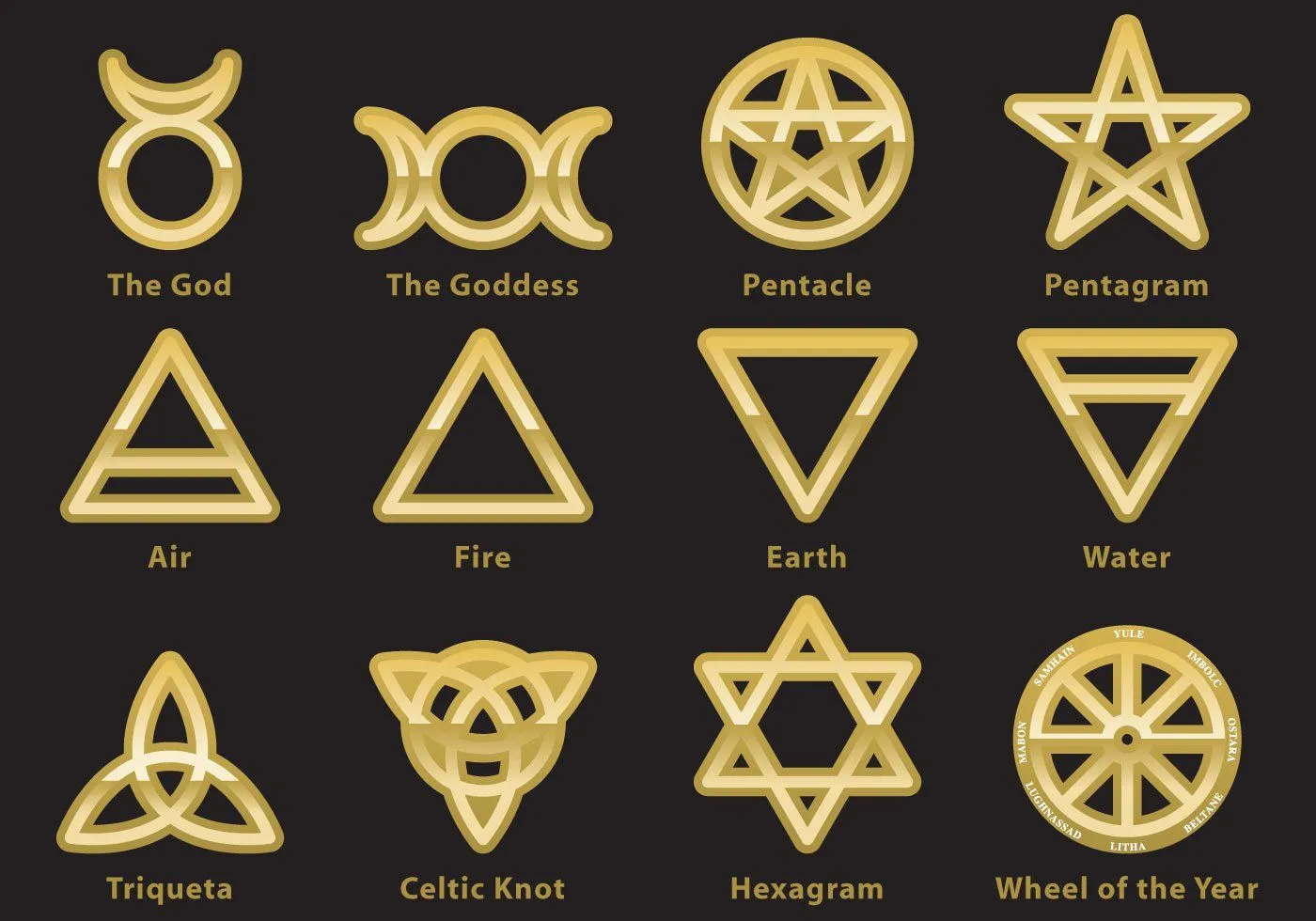
The Pentacle

The pentacle, sometimes referred to as a pentagram, is a magic symbol frequently used in Wicca and other pagan traditions. It features a five-pointed star (pentagram) enclosed within a circle. The pentacle is a powerful symbol of protection and represents the five elements: earth, air, fire, water, and spirit.

The Hexagram

The hexagram, also known as the Star of David or the Seal of Solomon, is a six-pointed star used as a magic symbol in various traditions. It symbolizes balance, harmony, and the union of opposites. In some traditions, it is associated with King Solomon and his supposed power to control demons and spirits.

The Crescent Moon

The crescent moon is a magic symbol associated with the feminine, cyclical nature, intuition, and change. It is often connected to lunar deities and used in rituals related to emotions, psychic abilities, and the subconscious.

The Infinity Symbol

The infinity symbol, resembling a figure eight on its side, represents limitlessness, eternity, and the interconnectedness of all things. It is often used to signify everlasting love, boundless potential, and the infinite nature of the universe.

Eihwaz

Eihwaz is a rune from the Norse runic alphabet, used in runes witchcraft and viking magic runes. It is associated with transformation, change, renewal, personal power, overcoming obstacles, balance, and stability.

The Ankh

The Ankh, an ancient magic symbol from Egypt, is known as the “Cross of Life.” It represents life, immortality, regeneration, and the union of male and female energies.

The Eye of Horus

Another ancient magic symbol from Egypt, the Eye of Horus, symbolizes protection, royal power, good health, restoration, and healing.

The Hamsa

The Hamsa is a palm-shaped amulet used in Middle Eastern cultures as a defense against the evil eye. It symbolizes protection, blessings, power, and strength.

The Evil Eye

The evil eye is a magic symbol used to ward off the “evil eye” curse, offering protection from malevolent gazes and negative energies.

The Triquetra

The Triquetra, a symbol consisting of three interlocked loops, represents the threefold nature of the goddess, the interconnectedness of mind, body, and spirit, and the three elements: earth, air, and water.

The Triskele (Triple Spiral)

The Triskele, with its three spiraling arms, symbolizes progress, action, competition, and the cycles of life – birth, life, and death.

The Om

Om, also known as Aum, is a sacred sound and symbol in Hinduism, Buddhism, and Jainism. It is believed to be the primordial sound of the universe, representing the connection between all things.

The Horned God

The Horned God is a deity in Wiccan and pagan traditions, embodying the male aspect of divinity, nature, and the cyclical flow of life.

The Triple Moon (Triple Goddess)

The Triple Moon symbol represents the three phases of the moon (waxing, full, and waning) and the Maiden, Mother, and Crone aspects of the Triple Goddess.

The Witch’s Knot

The Witch’s Knot, also known as the Magic Knot, is a magic symbol used for protection and warding off evil.

The Solar Cross

The Solar Cross, also known as the Sun Cross, represents the sun and the wheel of the year, symbolizing the cyclical nature of time and the passage of the seasons.

The Flower of Life

The Flower of Life is a geometric symbol composed of overlapping circles, considered a symbol of creation and the interconnectedness of all life.

Yin Yang

The Yin Yang symbol, from Chinese philosophy, represents the duality and balance of opposing forces in the universe.

Using Magic Symbols in Modern Practices

Today, magical symbols images are not only studied for their historical and cultural significance but are actively used in various modern magical and spiritual practices. Whether for magic symbols tattoos, exploring witch symbols and meanings, creating fantasy magic symbols, or simply seeking magical symbols images with names, their applications are vast. Even black magic symbols, while powerful and requiring careful consideration, are part of this broader exploration.

The History of Magic Symbols

  • Ancient Civilizations: The Earliest Use of Magic Symbols Magic symbols have been used for thousands of years, dating back to ancient civilizations such as the Egyptians, Greeks, and Romans. These symbols were often used in religious ceremonies and rituals to invoke the gods and to ask for protection, fertility, and good fortune.
  • The Use of Magic Symbols in the Middle Ages During the Middle Ages, magic symbols became associated with the occult and were used by alchemists, astrologers, and other esoteric practitioners. They were believed to have the power to control the elements, summon spirits, and bring about good luck and prosperity.
  • Magic Symbols in Modern Times Today, magic symbols continue to be used in various forms, from tattoos and jewelry to esoteric practices and rituals. While some people use these symbols for spiritual purposes, others use them as talismans for protection or as a way to connect with their personal beliefs and values.
magic symbols,
Magic Symbols

How to do magic symbols?

Creating your own magic symbols can be a deeply personal and symbolic process. Here’s a basic guide on how to create and use magic symbols:

  1. Set Your Intention: Before creating a magic symbol, it’s important to have a clear intention or purpose in mind. What do you want the symbol to represent or achieve? Be specific and focused on your goal.
  2. Choose a Method: There are various methods for creating magic symbols, and you can choose one that resonates with you. Some common methods include:
    • Freehand Drawing: You can simply draw a symbol that feels right to you. Let your intuition guide you as you create the design.
    • Alphabet-Based: Some magical systems use alphabets like the Theban alphabet, Enochian script, or runes to create symbols. You can use these alphabets to encode your intention.
    • Chaos Magic: Chaos magicians often create symbols by combining different elements and shapes to represent their desires. There are no strict rules in chaos magic, so it’s very individualistic.
    • Kabbalistic and Hermetic Systems: These systems have their own symbols and correspondences that can be used to create magical sigils.
  3. Design Your Symbol: Start designing your symbol based on your chosen method. Keep it simple and focused on your intention. Symbols can be made of lines, curves, dots, or a combination of these elements.
  4. Charge the Symbol: Charging a symbol is the process of infusing it with energy and intent. There are various ways to charge a symbol:
    • Meditation: Meditate on the symbol while focusing on your intention. Visualize your desire coming to fruition.
    • Ritual: Perform a ritual that aligns with your intention. This could involve candles, incense, and other ceremonial tools.
    • Sexual Energy: Some practitioners use sexual energy to charge symbols. This is a controversial and advanced technique, so exercise caution.
  5. Activate and Release: Once your symbol is charged, you can activate it. This can involve various methods, such as burning the symbol, burying it, or keeping it in a sacred space. The key is to release the energy and intention into the universe.
  6. Keep Records: It’s important to keep a record of your symbols and their corresponding intentions. This allows you to track their effectiveness and refine your magical practice over time.

Remember that working with magic symbols can be highly personal, and there is no one-size-fits-all approach. Your belief and intention are crucial elements in making these symbols work for you. Additionally, it’s important to approach

The Significance of Magic Symbols

  • The Power of Symbolism Magic symbols hold a deep and powerful symbolism that transcends cultural and historical boundaries. They are often used as a visual representation of energy, thoughts, and beliefs, and can evoke strong emotions and responses.
  • The Role of Magic Symbols in Personal Growth and Transformation For many people, the use of magic symbols can be a powerful tool for personal growth and transformation. They can serve as a reminder of one’s goals, beliefs, and aspirations, and help to bring focus and clarity to one’s life.
  • The Use of Magic Symbols in Rituals and Ceremonies Magic symbols play an important role in various rituals and ceremonies, including Wiccan and pagan practices. These symbols serve as a focal point for the energies being invoked, and can help to create a powerful and meaningful experience.
magic symbols,
Magic Symbols

Types of Magic Symbols

Magic symbols have been used for centuries to bring about change, protection, and the manifestation of one’s desires. These symbols can be found in various cultures and spiritual practices, each with its unique meaning and purpose. Here are some of the most popular types of magic symbols:

  1. Runic magic symbols: These are ancient Nordic symbols used for divination and protection. Each symbol holds a specific meaning and can be used in spell work and manifestation.
  2. Egyptian hieroglyphics: These symbols are the ancient writing system of the Egyptians and were believed to have magical properties. The symbols represented gods, pharaohs, and the afterlife, and were used in religious ceremonies and spell work.
  3. Alchemical symbols: These are symbols used in alchemy, an ancient philosophy that aimed to transform matter into gold and discover the elixir of life. Alchemical symbols represent elements, compounds, and processes and are still used in modern magic and spirituality.
  4. Tarot symbols: The Tarot is a deck of cards used for divination and self-discovery. Each card has a unique symbol that represents an aspect of life and the human experience.
  5. Planetary symbols: In astrology, each planet is associated with a specific symbol that represents its influence and energy. These symbols are used in spell work and manifestation to harness the energy of the planets.
  6. Pentagram: The pentagram is a five-pointed star that is often associated with magic and spirituality. It represents the elements of Earth, Air, Fire, Water, and Spirit and is used for protection and manifestation.
  7. Hamsa: The Hamsa is a symbol originating from the Middle East and is believed to bring good luck, and protection, and banish negative energy. It is often used in amulet form and can be found in various cultures and spiritual practices.
magic symbols,
Magic Symbols

Dark magick symbols

Dark magic symbols or black magic have been around for centuries, and they are often associated with the darker side of the occult. They can be used for protection, curses, and other dark magickal purposes.

Dark magic symbols are usually associated with death using some Dark Rituals, destruction, and chaos. They are used to invoke powerful forces or entities that can cause harm or manipulate the environment. This type of magick is often used to manipulate or control people or situations, and it is not recommended for beginners.

Dark magic symbols can be found in a variety of forms, including runes, sigils, and glyphs. Runes are ancient symbols that were used by the early Celts, Norse, and other cultures for magickal purposes. Sigils are symbols that are used to represent a particular entity or power. Glyphs are symbols that are used to represent a particular concept or emotion.

When using dark magic symbols, it is important to keep in mind that they are powerful and should be used with caution. It is also important to be aware of the consequences of using dark magic, as it can have a negative effect on your life.

Dark magic symbols can be used in a variety of ways. They can be used to summon dark forces, to cast curses, or to create powerful talismans and charms. It is important to understand the power of the symbols you are using and to use them responsibly.

Dark magick symbols can be found in books, online, or in occult stores. It is important to research the symbols you are using and to understand their meaning before attempting to use them. It is also important to be aware of the consequences of using dark magick, as it can have a negative

Magic Symbols
Magic Symbols

Conclusion

Magic symbols are more than just pictures; they are keys to unlocking deeper spiritual truths and connecting with the mystical forces that shape our world. Whether you are drawn to ancient magic symbols, exploring magic symbols and meanings, or interested in contemporary uses of all magic symbols, understanding these symbols opens doors to new dimensions of spiritual and personal power. Exploring witch symbols and meanings can provide valuable insights into various magical traditions.

43 thoughts on “Magic Symbols: What They Actually Do”

  1. I?ve read a few excellent stuff here. Certainly value bookmarking for revisiting. I surprise how much effort you put to make this type of excellent informative about magic symbols .

  2. magic sumbols !!!! F*ckin? amazing things here. I?m very glad to see your post. Thanks a lot and i’m looking forward to contact you. Will you please drop me a e-mail?

  3. Pingback: 7 Powerful Secrets of the Sigil Witch - Witch symbols

  4. Pingback: 10 Ancient Witchcraft Symbols Every Modern Witch Should Know - Witch symbols

  5. Pingback: The Power of Paganism Spells: A Beginner’s Guide - Witch symbols

Leave a Comment

Your email address will not be published. Required fields are marked *