
You may asked your self ” Which religions believe in Satan?”, Well Imagine a horned, red devil grinning back at you – that carnival statue above is exactly the kind of image pop culture throws at us when we think of Satan. Ever wondered, though, which faiths actually talk about Satan at all? You might assume Christianity has a Devil, but what about Judaism or Islam, or even older religions? Spoiler: it’s more complex than movies let on. Let’s untangle the myths and see who (if anyone) really “follows” Satan.
Christianity: Satan as the Fallen Angel
When we say “Satan,” Christians usually come to mind first. In traditional Christian teaching, Satan is very real – the ultimate rebel. MyJewishLearning puts it bluntly: “Satan occupies a prominent place in Christianity, which generally regards him as a rebellious angel and the source of evil…”. Think of the devil tempting Jesus in the desert or prowling among us as the author of sin. In this story, Satan will even face his “ultimate demise” at the End of Days. In short, Christianity treats Satan as a personal being – a fallen angel who turned rogue.
Judaism: Satan as an Adversary, Not a Devil
What about Judaism? Now here’s a surprise: Jews do talk about a “satan,” but it’s nothing like the Christian Devil. In Hebrew the word satan literally means “adversary” or “accuser,” not a name. The idea often shows up in the Hebrew Bible (Job, Zechariah) as an angelic prosecutor who tests people’s faith. Jewish sources, as one guide notes, “don’t dwell as much on the satanic,” but they do use the term in a very different way. In fact, Chabad.org insists that “Judaism doesn’t believe in the devil or that evil has any independent power whatsoever.” Instead, “satan” is just an agent who “turns people astray” – kind of a divine prosecutor rather than a king of Hell. Some rabbis even equate Satan with the yetzer hara (the “evil inclination”) inside everyone. So no, Judaism doesn’t have a Devil-on-a-throne; it has a tester of faith with God’s permission.
Islam: Iblīs and the Shayāṭīn
What about Islam? Muslims do have a figure quite similar to the Devil: the jinn Iblīs. As one source explains, Muslims use two terms – Iblīs for the specific being who refused God’s command, and shayṭān (Shaitan) as a general label for any rebellious entity. According to the Quran, Iblīs was a jinn (not even an angel) who wouldn’t bow to Adam. Cast out of heaven for arrogance, he became the arch-tempter – the Islamic “Satan.” And shayṭān (same root as “Satan”) can describe any evil spirit. So in Islam, there is a Devil, but it’s Iblīs the jinn, not a fallen angel like in the Christian story.
Ancient Roots: Zoroastrianism and the Prototype of Satan
And what about older or other religions? Well, fun fact: the very idea of a Devil-like character may trace back to Zoroastrianism. In ancient Persia, the spirit Angra Mainyu (Ahriman) was literally the “Evil Spirit” opposed to God. Britannica notes that later Zoroastrian thought calls Angra Mainyu “the great adversary Ahriman (the prototype of the Jewish, Christian, and Islamic Satan)”. In other words, the cosmic battle between Ahura Mazda and Ahriman likely influenced later Devil myths. Many scholars believe this Persian dualism seeded the devil and demon concepts in the Hebrew Bible and New Testament.
Religions Without a Devil Figure
That doesn’t mean every faith has a Satan figure. Eastern religions often conceptualize evil differently. For example, the Baha’i Faith views “Satan” symbolically – not as a real being but as our own lower ego getting in the way of the divine. Hinduism and Buddhism talk about demons (asuras, rakshasas, Mara, etc.), but they aren’t the one Devil that commands all evil. Every tradition carves its own path: one person’s fiend is another’s metaphor for inner struggle.
Satanism: Symbolism, Not Devil Worship
Now let’s talk Satanism – because many people jump to Satanism when hearing “religions and Satan.” Here’s the kicker: most self-described Satanic groups actually do not worship Satan as a literal devil. The Church of Satan (founded by Anton LaVey) is famously atheistic. In their view, “Satanism” is a philosophy, not devil-worship. As ReligionFacts explains, the Church of Satan “neither worships the Judeo-Christian devil nor does it believe in [the devil’s] existence”. They use “Satan” as a symbol of human nature, freedom, or even fun rebellion, not a supernatural master. (In fact, LaVeyan Satanists see him as a metaphor for our hidden desires.)
Baphomet, Symbolism, and Fringe Beliefs
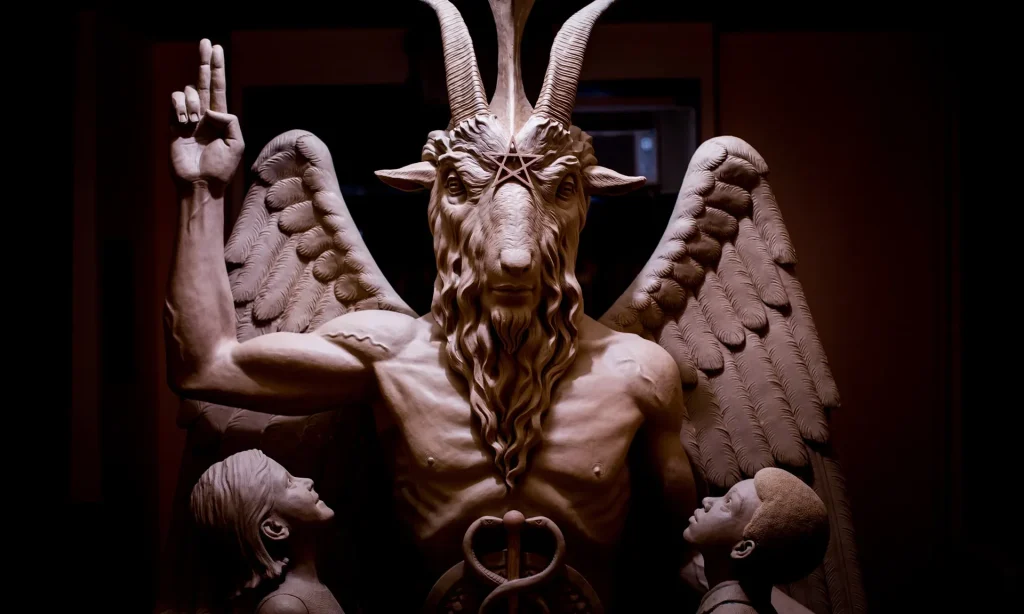
Consider Baphomet above, the classic horned goat-god image drawn by Éliphas Lévi in 1856. It’s become an occult icon often linked to Satan in pop culture. But notice: this is 19th-century artwork, not scripture! Groups like the Church of Satan or The Satanic Temple might use such imagery on stage or in logos, but their beliefs aren’t about a coming apocalypse ruled by this goat figure. The Satanic Temple, for instance, uses Satanic symbolism to promote secular activism, not to praise an evil deity. There are tiny fringe groups that actually theoretically worship Satan as a pagan god, but they’re very obscure — think internet corners or shock-value cults, not something mainstream.
Which religion follows Satan?
In a word: none of the big world religions do. No major faith says “Let’s follow Satan instead of God.” Even groups called “Satanists” usually aren’t what you think. We already saw that the Church of Satan explicitly rejects devil worship, and The Satanic Temple is non-theistic. Sure, small neo-pagan or occult circles might style themselves as “worshippers of Satan,” but they’re nowhere near major organized religions (and often blend Satan with other deities or symbols). Bottom line: no widespread faith officially promotes Satan as its leader or focus.

Is Satan the same in all religions?
Absolutely not. It’s a huge mistake to assume one Satan fits all traditions. Even the same name often refers to very different ideas. As one expert puts it, each religion has “its own very unique perspective and description” of Satan. In Christianity he’s a fallen angel; in Judaism, a trusted accuser; in Islam, a disobedient jinn. Zoroastrians had Ahriman; Baha’is say he’s our lower self; LaVeyan Satanists use him as metaphor. The stories overlap (and borrowed from each other), but they aren’t identical. In fact, Britannica notes that Western monotheisms simply “widespread belief in… demons, and evil spirits” as a category, but each faith has its own narrative about them. So no – Satan isn’t a universal guy shaking hands across every faith.
How many religions believe in demons?
A lot of them, it turns out. Any religion that talks about evil often has some flavor of demons or devilish beings. Christianity, Judaism, Islam – yes. Zoroastrianism – yes (Ahriman and the daevas). Hinduism and Buddhism have rakshasas or asuras. Even folk religions and animist traditions often believe in malicious spirits. Britannica sums it up: in popular piety of major faiths there is “a widespread belief in ghosts, ghouls, goblins, demons, and evil spirits” that affect human life. Basically, if a religion has a moral tug-of-war, there’s usually something bad on the other side, whether you call it a demon, devil, or just karma and cosmic justice.
Do Jews believe in Satan?
This one trips people up. Jews certainly know the term satan and mention it in texts, but mainstream Judaism emphatically does not worship or even acknowledge a devil as an independent evil force. A classic line from Chabad.org: “Judaism doesn’t believe in the devil or that evil has any independent power whatsoever”. Instead, every Jew grows up hearing that satan (adversary) is really just an angel doing God’s bidding, or even the inner struggle inside each person. The Book of Job famously has “the Satan” in God’s court testing a righteous man – hardly a “Satanist’s master plan.” In practical terms, most Jews see Satan as either a metaphor for temptation or as God’s sous-chef in justice, not a bad guy on his own quest. So the short answer: Judaism has a concept of satan, but it’s not a demonic devil; it’s more like a prosecutor or personification of the evil impulse



Pingback: What Does The Satanic Bible Talk About? - Witch symbols
Pingback: Satanic Ritual Books: Spells, Rituals, Worship - Witch symbols
Pingback: The Complex World of Satanic Rituals: Practices and Impacts - Witch symbols
Pingback: Demystifying Satanic Rituals: Unveiling the Truth Behind Misconceptions - Witch symbols
Pingback: Top 10 Satanic Signs and Their Meanings - Witch symbols