What happens when the alchemist’s crucible meets the witch’s cauldron? For centuries, these two figures, the proto-scientist and the magic practitioner, seemed worlds apart, yet their arts flow from the same ancient spring of wisdom. The sacred union of alchemy and witchcraft gives rise to a powerful modern path: alchemy witchcraft. This journey blends the alchemist’s deep, internal work of purification with the witch’s practical magic of manifestation. The modern alchemist witch understands that both arts seek to transform the lead of ordinary life into the pure gold of the soul, turning the quest for transformation into a living, breathing practice.
What is an Alchemist in Witchcraft?
In the quiet of the laboratory or a moonlit clearing, the alchemist and the witch both work as agents of transformation. For centuries, these two figures seemed to walk separate paths, one a proto-scientist, the other a practitioner of magic—but their arts spring from the same ancient wisdom. The sacred union of these traditions gives rise to a powerful modern path: alchemy witchcraft. This journey is about uniting the crucible and the cauldron, blending the alchemist’s internal work of purification with the witch’s practical magic of manifestation. While history often drew a sharp line between them, viewing alchemy as a flawed natural philosophy and witchcraft as dangerous heresy, their souls are deeply intertwined. Both seek to understand the hidden patterns of the universe and work with its subtle energies to create profound change, a purpose rooted in the Hermetic principle, “As Above, So Below.”
This fusion is an act of spiritual reclamation. Historically, alchemy was often the pursuit of a male-dominated intellectual elite who coded their work, while witchcraft was associated with the intuitive, nature-based wisdom of folk healers and “wise women” who were often brutally persecuted. The alchemist might be accused of fraud, but the witch was condemned for heresy—a stark difference revealing their unequal places in society. The contemporary path of the alchemist witch heals this historical schism, asserting that the alchemist’s “Great Work” is the birthright of every soul seeking to transform the lead of their life into the pure gold of their truest, most magical self.
The Mystical Union of Alchemy Witchcraft
To understand the power of alchemy in witchcraft, one must look beyond the surface of bubbling potions and transmuting metals and into the shared metaphysical heart of both traditions. This is not a forced pairing but a natural reunion of two arts that spring from the same universal truths. At their core, both alchemy and witchcraft operate on the fundamental belief that the universe is a living, interconnected, and responsive entity.
This shared worldview begins with the concept of the Prima Materia, or “First Matter”. To the alchemist, this was the primordial, formless substance—a state of pure potential or chaos—from which all of creation emerged. For the witch, this is a deeply familiar concept. It is the raw, untamed energy of possibility that exists before a spell is cast, the sacred emptiness from which all manifestation is born. It is the darkness of the new moon, pregnant with all that could be. Both the alchemist and the witch draw from this same wellspring of creation to begin their work.
This living universe is animated by what alchemists called the Anima Mundi, or the World Soul. This is the belief that a single, universal spirit connects all things—every stone, plant, star, and soul. Witches know this truth intimately; it is the web of life that makes magic possible. A spell to attract love works because the energy of a rose, the flame of a pink candle, and the intention in the witch’s heart are all part of the same conscious, interconnected whole. The alchemist’s work in the laboratory was understood to be a mirror of the work happening within their own soul; the purification of the metals corresponded directly to the purification of the spirit. This is the very essence of witchcraft, where a spell is not merely a set of external actions but a profound alignment of one’s inner state—the intention—with the desired outer reality.
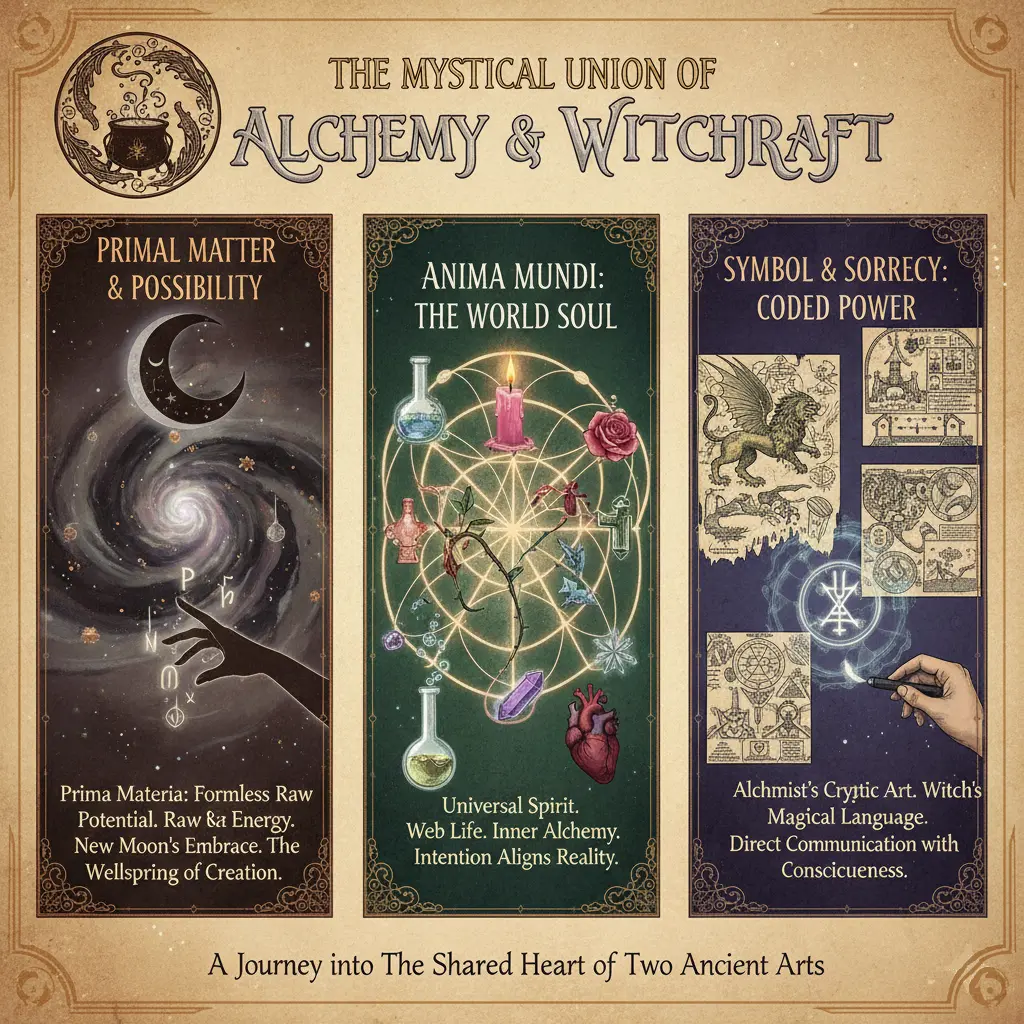
This parallel understanding reveals a deeper layer of connection. The famously cryptic and symbolic language of alchemy—the dragons, green lions, and chemical weddings depicted in ancient texts—was not created solely to hide secrets from the uninitiated or to evade the watchful eye of the Church. While secrecy was certainly a factor, this symbolic language was a form of magical technology in itself. These images and allegories were designed to bypass the rational mind and speak directly to the subconscious, to “activate imagination and to generate feelings” that would catalyze the alchemical transformation.
Modern witches understand this principle intuitively through the practice of sigil magic, where a symbol is charged with a specific intent to manifest a goal. Different magical systems, from Wicca to Hermeticism, are ultimately different symbolic “languages” used to interpret and interact with the unseen forces of reality. Therefore, the alchemist’s coded art and the witch’s sigil are two expressions of the same magical law: a potent, non-literal symbol can communicate directly with the deeper, creative consciousness of the universe—the Anima Mundi. This allows the modern witch to view ancient alchemical engravings not as historical curiosities, but as a powerful grimoire of magical symbols, ready to be understood and integrated into their own practice.
The Three Pillars of the Alchemist Witch: Soul, Spirit, and Body
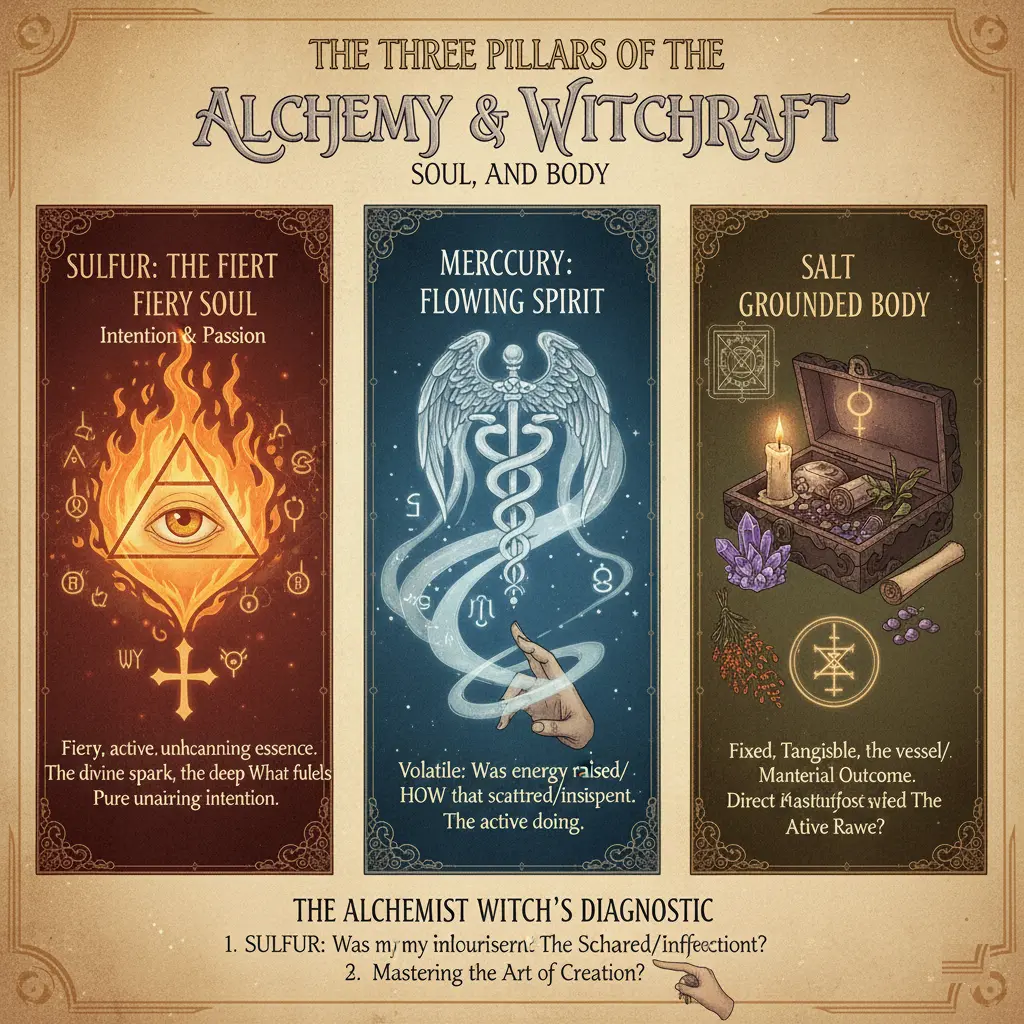
At the heart of alchemical philosophy lies a sacred trinity known as the Tria Prima, or the Three Principles: Sulfur, Mercury, and Salt. These are not the common substances found in a laboratory but are archetypal forces that constitute all of existence, from a stone to a star to a human being. For the alchemist witch, these three principles provide a profound framework for understanding the anatomy of magic itself. They are the soul, spirit, and body of every spell, ritual, and act of manifestation. By mastering these principles, a witch can move from simply following magical “recipes” to truly understanding and engineering the forces of creation.
Sulfur: The Fiery Soul of Your Intention
In alchemy, Sulfur represents the soul, the consciousness, and the essential, unchangeable nature of a thing. It is the fiery, active, and masculine principle, born from the combination of the elements of Fire and Air. In the context of witchcraft, Sulfur is the pure, unwavering intention behind your magic. It is the divine spark that ignites the entire working. It is not just the goal you wish to achieve, but the deep, passionate why that fuels it. A spell for prosperity is not merely a desire for money; its Sulfur is the soul-deep yearning for security, freedom, and the ability to care for loved ones. This principle is fixed and constant; if your intention is weak, conflicted, or lacking in passion, the “soul” of your spell is weak, and its power will be diminished from the start.
Mercury: The Flowing Spirit of Your Magick
Mercury is the vital, life-giving spirit that acts as the bridge between the soul (Sulfur) and the body (Salt). It is the messenger of the gods, a volatile and mutable force born of Air and Water that connects the heavenly and earthly realms. In a magical working, Mercury is the energy you raise and direct. It is the cone of power built through chanting, the focused visualization that shapes the spell, the emotional current poured into the working. It is the active “doing” of the magic, the flow of power that carries the fiery intention of Sulfur and delivers it to a physical vessel. If Sulfur is the “why,” Mercury is the “how.” Without a strong and focused flow of Mercury, the most passionate intention remains an unrealized dream, unable to cross the veil into manifestation.
Salt: The Grounded Body of Your Spell
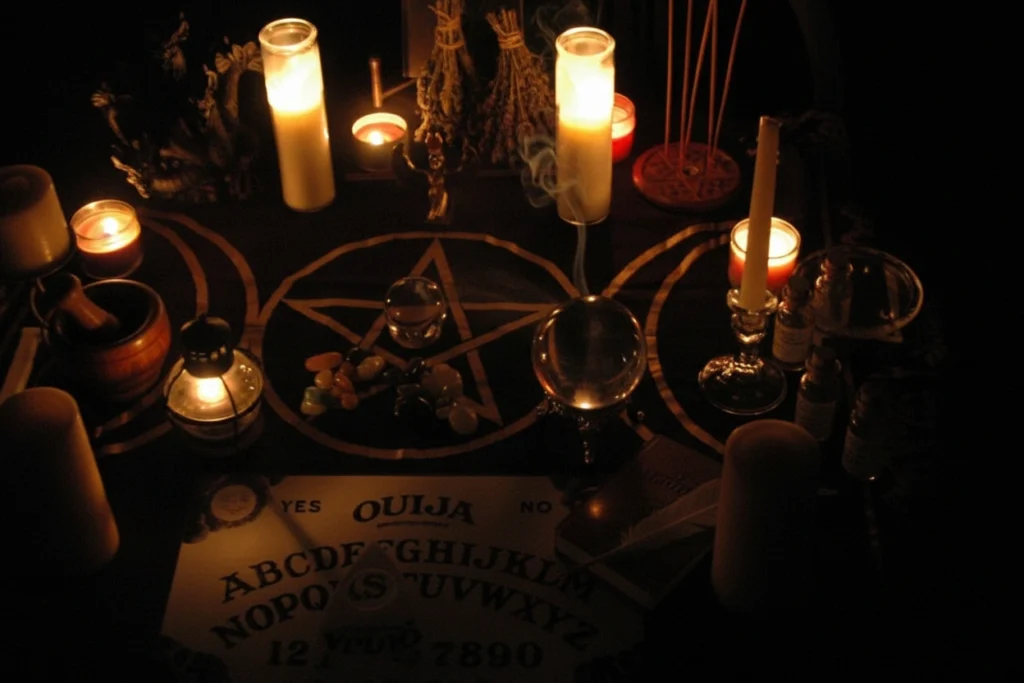
Salt is the third principle, representing the body, physical matter, and the force of stability and crystallization. It is born of Earth and Water, giving it a fixed and tangible nature. In your spellcraft, Salt is the material foundation of your working. It is the herbs, crystals, and candles on your altar; the wax of the poppet; the ink and paper of a written petition. It is also the final, manifested outcome you seek in the physical world. Salt is the vessel that receives and holds the fiery soul of Sulfur and the flowing spirit of Mercury, giving the spell a concrete form and anchoring it in reality. An improperly cleansed candle, an inappropriate herb, or a poorly defined outcome creates a flawed “body” for your spell, one that may struggle to contain and express the power you pour into it.
This alchemical trinity offers more than just a philosophical model; it provides a powerful diagnostic tool for the practical witch. When a spell fails, fizzles, or backfires, it is often due to an imbalance between these three principles. Instead of relying on vague intuition alone, the alchemist witch can analyze the working with precision. Was the Sulfur weak or impure? (Was my intention unclear, conflicted, or lacking true passion?) Was the Mercury insufficient or scattered? (Did I fail to raise enough energy, or was my focus broken during the ritual?) Was the Salt flawed or unstable? (Did I use the wrong physical correspondences, or was the material vessel for the spell improperly prepared?) This framework transforms magical troubleshooting from a guessing game into a refined art, allowing the practitioner to learn from every working and continually perfect their craft.
The Great Work: An Alchemical Map for the Witch’s Soul
The ultimate goal of the alchemist was the Magnum Opus, or the Great Work: a long and arduous process of transformation culminating in the creation of the legendary Philosopher’s Stone. This stone was said to be capable of transmuting base metals like lead into pure gold and granting immortality. However, the most perceptive alchemists understood that the true Great Work was not performed in a furnace upon metals, but within the furnace of the human soul. The transmutation of lead into gold was always a profound metaphor for the journey of spiritual evolution—the purification of the imperfect, mortal self into a state of enlightened, divine consciousness. For the modern witch, the stages of the Magnum Opus provide a powerful and resonant map for their own spiritual journey.
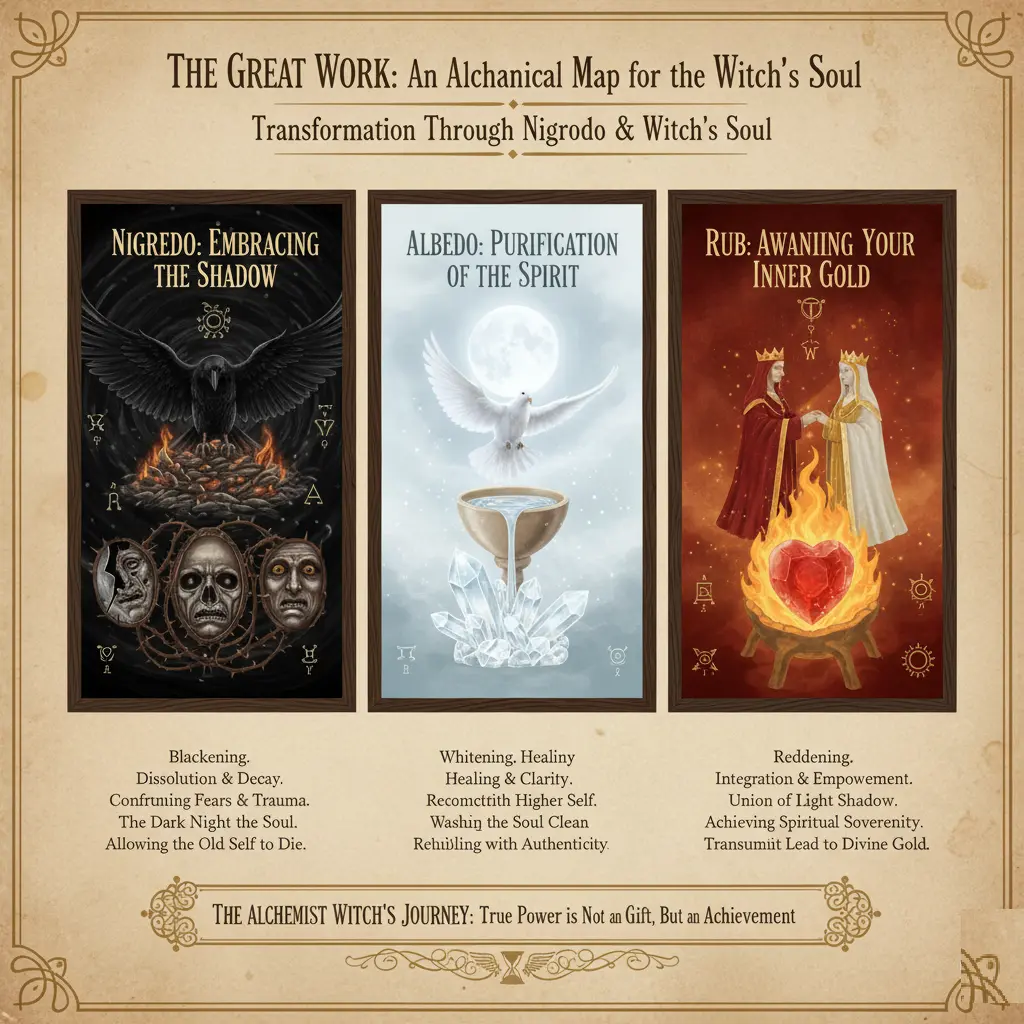
Nigredo (The Blackening): Embracing the Witch’s Shadow
The Great Work begins in darkness. Nigredo, or the blackening, is the first and most challenging stage. It is a process of dissolution, decomposition, and putrefaction, where the starting material is broken down, burned to ash, and reduced to its most basic, chaotic state. Alchemical texts symbolize this stage with images of death, decay, ravens, and skulls. This is the alchemical “dark night of the soul,” and it is a territory intimately familiar to the dedicated witch.
This stage corresponds directly to the vital practice of shadow work. It is the courageous act of turning inward to confront the “base metal” of one’s own psyche: the fears, traumas, limiting beliefs, and repressed aspects of the self that have been hidden away in the darkness of the unconscious. It is a painful but necessary process of deconstruction, of allowing the old, limited self to “die” so that something new and more authentic can be born from the ashes. Many who begin the path of witchcraft are drawn to it precisely because they are entering a personal Nigredo, seeking tools to navigate the chaos of their own inner world.
Albedo (The Whitening): The Purification of the Spirit
Out of the darkness of Nigredo, a new light emerges. Albedo, the whitening, is the stage of purification and washing. The black ash from the alchemical fire is cleansed, and a brilliant, pure whiteness appears, symbolized by the white dove or swan. This signifies that the soul has been stripped of its dross and its pure, essential nature has been revealed.
In the witch’s journey, Albedo is the phase of healing and clarity that follows the difficult work of the shadow. It is the spiritual cleansing after a cord-cutting, the profound peace found in meditation, the moment of deep insight when a long-held pattern is finally understood and released. It is the process of reconnecting with one’s higher self, spirit guides, or deities, and washing the soul clean in the waters of spiritual truth. After the deconstruction of Nigredo, Albedo is the conscious act of rebuilding the self on a foundation of authenticity, wisdom, and inner light.
Rubedo (The Reddening): Awakening Your Inner Gold
The final stage is Rubedo, the reddening. Here, the purified essence from Albedo is reunited with the fiery soul, a process often symbolized as the “chemical wedding” between the White Queen (the purified body/matter) and the Red King (the spirit/Sulfur). Their union gives birth to the Philosopher’s Stone, a substance of ruby-red perfection that represents the culmination of the Great Work.
For the alchemist witch, Rubedo represents the ultimate state of empowerment and integration. It is the unification of the shadow and the light, the conscious and the unconscious, the self and the divine. This is the achievement of spiritual sovereignty. A witch who has reached this stage no longer simply performs magic; they have become the magic. Their will is aligned with the will of the universe, and their ability to create change in themselves and the world is magnified exponentially. They have successfully transmuted the lead of their ordinary consciousness into the living gold of their divine self.
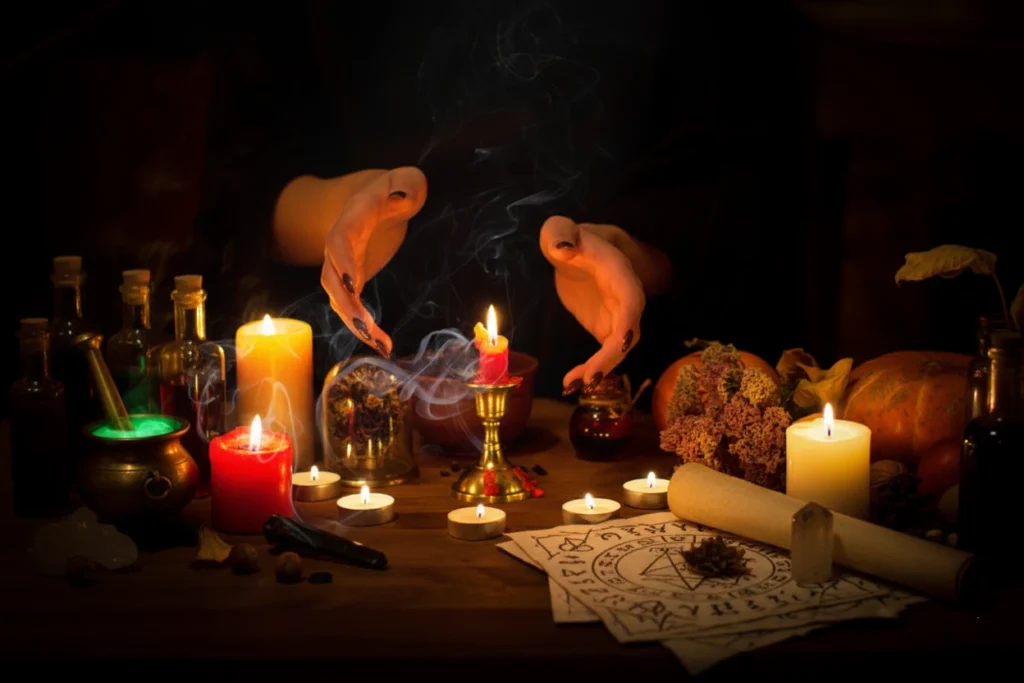
This alchemical map offers a deeply empowering perspective. It reframes the idea of a “powerful witch” not as someone who was born with special gifts, but as someone who has bravely undertaken their own Great Work. Popular culture often depicts magical ability as an innate, effortless talent. The Magnum Opus teaches a different truth: true power is not a gift but an achievement. It is forged in the fires of self-confrontation. The most potent witches are not those who have avoided suffering, but those who have learned to use their personal hardships as the Prima Materia for their own transformation. They have faced their Nigredo, purified their pain in the Albedo, and emerged into the radiant power of the Rubedo, turning the heaviest burdens of their lives into their greatest source of strength.
Practical Alchemy in Witchcraft: Bringing the Great Work to Your Altar
The profound philosophy of alchemy does not have to remain an abstract concept. The principles of the Great Work can be brought directly to the witch’s altar and integrated into practical, hands-on magic. Alchemy in witchcraft is a living art, one that enriches herbalism, deepens spellcraft, and empowers the creation of magical tools. By engaging in these practices, the modern witch can experience the transformative journey of the alchemist in a tangible and personal way.
Spagyrics: Alchemical Herbalism for the Modern Witch
Perhaps the most direct and accessible form of practical alchemy for a witch is the art of spagyrics. Often called the “minor work,” spagyrics applies the principles of the Magnum Opus to the plant kingdom. It is a method of creating herbal remedies that goes far beyond a simple tea or tincture. A spagyric preparation is a holistic essence that captures the complete being of a plant—its body, spirit, and soul—by separating, purifying, and reuniting its core principles.
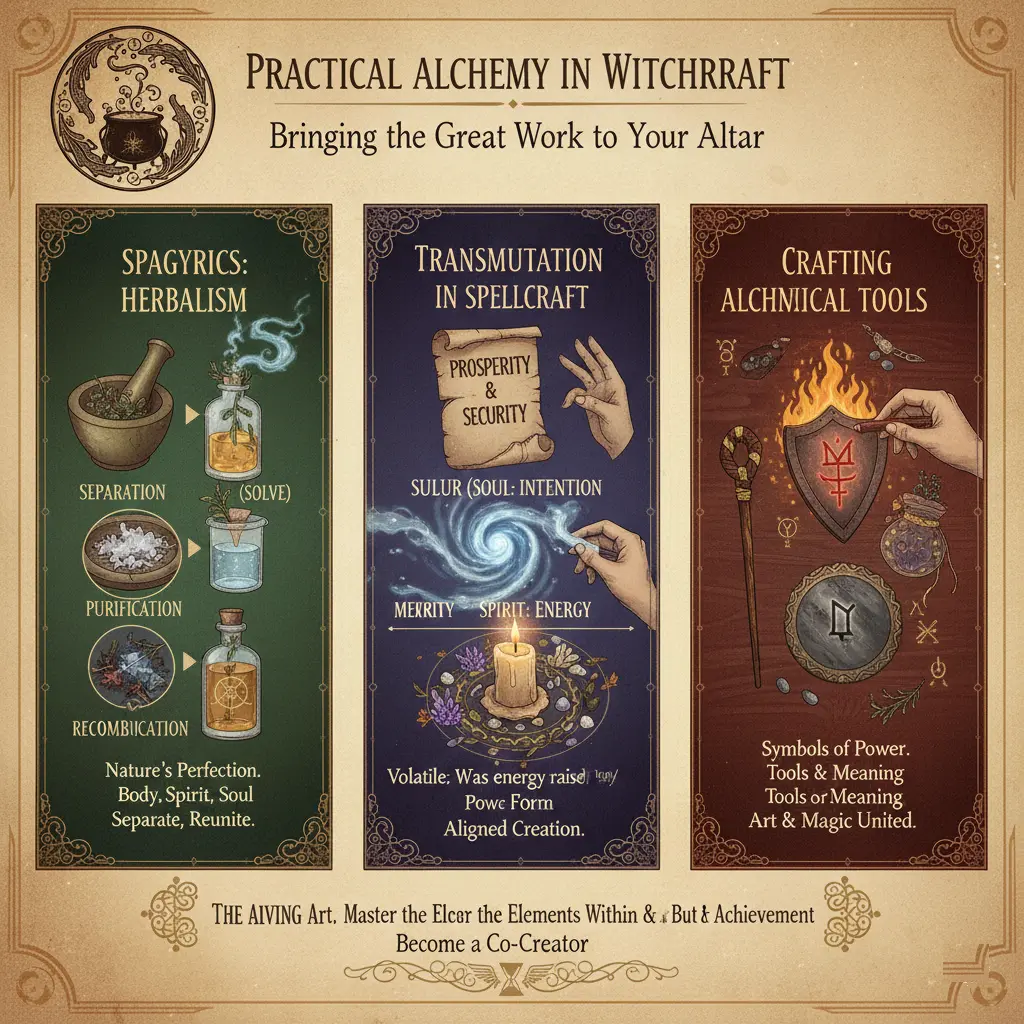
The process, summarized by the alchemical maxim Solve et Coagula (“dissolve and coagulate”), follows three key stages :
- Separation (Solve): The first step is to break the plant down into its three principles. This is often done by fermenting the plant material to produce alcohol, which is considered its Mercury, or Spirit. The essential oils, which carry the plant’s unique character and aroma, are then extracted, representing its Sulfur, or Soul.
- Purification: The remaining plant matter, the physical “body,” is not discarded. It is carefully burned down to a fine, white ash through a process called calcination. This ash is then purified, typically with distilled water, to extract the plant’s pure, crystalline mineral salts. This is its purified Salt, or Body.
- Recombination (Coagula): In the final, magical step, the three purified principles are reunited. The mineral salts (Salt) are dissolved back into the alcohol (Mercury), and the essential oils (Sulfur) are added. The result is a potent elixir that is more powerful, spiritually alive, and medicinally effective than any of its parts alone.
This practice reframes the witch’s relationship with the plant world. It is a shift from simply using nature’s gifts to actively participating in their perfection. The witch becomes a co-creator, a spiritual partner who helps the plant spirit achieve its highest possible expression. In return, the perfected plant essence offers its magnified power for healing and magic. This is a sacred act of reciprocity, embodying the deepest principles of green witchcraft through an alchemical lens.
Transmutation in Spellcraft: Changing Reality from the Inside Out
At its heart, all spellcasting is an act of transmutation. The witch does not create something from nothing; she transforms one state of reality into another. A spell to banish negative energy transmutes a space of fear into one of safety. A glamour spell transmutes perception. A healing spell transmutes illness into wellness. By consciously applying the alchemical framework of the Tria Prima, a witch can make this process more deliberate and powerful.
A simple alchemical spell structure might look like this:
- Sulfur (The Soul): Begin by defining the fiery, unchanging core of your intention. Write it down in clear, powerful, and unequivocal terms on a piece of paper. This is the soul of your working.
- Mercury (The Spirit): Raise and direct the energy that will serve as the active, transformative agent. This could be through chanting, dancing, drumming, or intense visualization. As you build this energy, see it as the vital spirit that will carry your intention across the veil.
- Salt (The Body): Choose a physical vessel to ground the spell. This could be a candle, a crystal, a sachet of herbs, or a jar. Charge this object with the intention (Sulfur) and the energy you have raised (Mercury). This object becomes the stable, physical body of the spell, holding the magic as it works to manifest in the material world.
Crafting Alchemical Tools: Talismans and Enchanted Objects
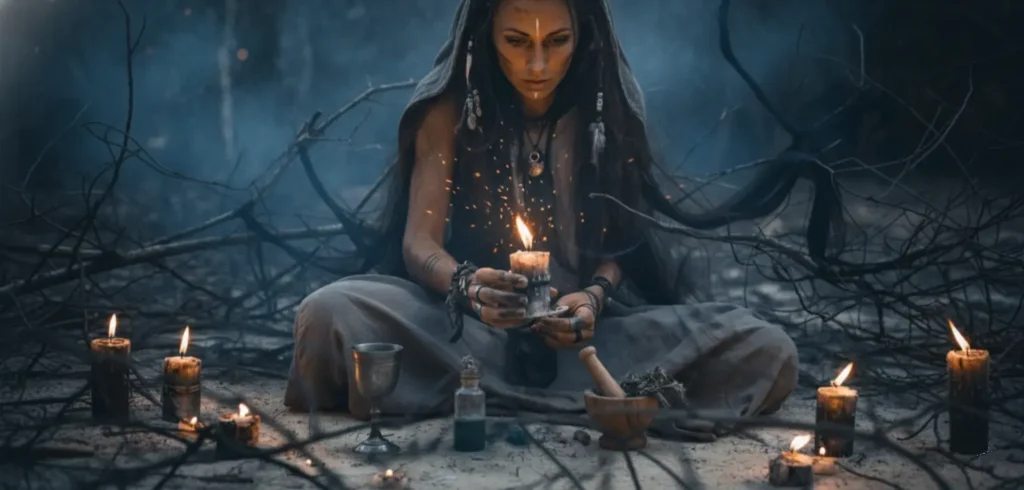
The rich symbolic language of alchemy provides a powerful vocabulary for enchanting magical tools. Alchemical symbols for the planets, elements, and the Tria Prima can be inscribed onto wands, athames, or talismans to imbue them with specific, potent energies. For example, a talisman for courage and protection could be crafted from iron (the metal of Mars) and engraved with the symbol for Sulfur (representing the fiery soul and will). A scrying mirror could have the symbol for Mercury (the bridge between worlds) etched on its back to enhance communication with spirit. This practice marries the intellectual, symbolic knowledge of the alchemist with the hands-on, creative artistry of the witch, creating tools of profound power and personal meaning.
Common Questions About Alchemy and Witchcraft
What’s the difference between a witch and an alchemist?
Historically, the main difference lies in their methods, goals, and social standing. Alchemists were early natural philosophers, a precursor to modern chemists, who focused on the transmutation of matter—famously turning lead into gold—and the creation of elixirs for health and immortality. Their work was often scholarly and experimental, and while sometimes viewed as fraudulent, they were typically punished for crimes like counterfeiting, not heresy. Witches, on the other hand, were often associated with folk traditions, herbalism, and nature-based magic. Their practices were frequently misunderstood and demonized, leading to brutal persecution for heresy and consorting with evil spirits, particularly during the European witch trials.
What is an alchemist in witchcraft?
An alchemist in witchcraft, or an “alchemist witch,” is a modern practitioner who integrates the principles of alchemy into their magical practice. This is not about literally turning lead into gold in a lab. Instead, it involves using alchemical concepts as a framework for spiritual growth and spellcraft. For example, an alchemist witch might use the stages of the alchemical Great Work—Nigredo (blackening), Albedo (whitening), and Rubedo (reddening)—as a powerful metaphor for personal transformation and shadow work. They may also apply the Three Principles (Sulfur, Mercury, and Salt) to better understand and structure their spells, viewing them as the soul, spirit, and body of a magical working.
What is the difference between magic and alchemy?
Magic is a broad, all-encompassing term for the practice of using intention, energy, and ritual to create change in the world. It includes a vast array of traditions and techniques, from spellcasting and divination to communicating with spirits. Alchemy can be considered a specific and highly structured form of magic that intersects with natural philosophy and proto-science. While magic can be purely intuitive or spiritual, alchemy historically involved defined laboratory processes, a complex theoretical framework, and specific goals like the transmutation of metals and the creation of the Philosopher’s Stone. In short, all alchemy can be seen as a type of magic, but not all magic is alchemy.
Is alchemy witch real or fake?
This depends on what one considers “real.” Historically, both alchemy and witchcraft were very real practices and belief systems. Alchemy was a serious intellectual pursuit for centuries and laid the groundwork for modern chemistry, even if its goal of creating gold from lead is not possible as they envisioned it. In a modern spiritual context, the path of the alchemist witch is a real and valid one for its practitioners. The focus is not on the literal, physical transmutation of metals but on the metaphorical transmutation of the self. Practitioners use alchemical symbolism and philosophy as a powerful tool for personal development, psychological integration, and spiritual enlightenment. Therefore, as a spiritual framework and a path of self-discovery, it is very real to those who walk it.
Conclusion: Embodying the Alchemist Witch
The path of alchemy witchcraft is not about learning two separate disciplines, but about awakening to the reality that they are two faces of the same golden coin. It is the sacred art of recognizing that the alchemist’s laboratory is the witch’s own soul, and the witch’s altar is the alchemist’s crucible for transformation. This journey teaches that every act of magic is an act of transmutation, and every moment of personal growth is a step in one’s own Great Work.
To walk this path is to understand that the principles of alchemy are not confined to ancient, dusty tomes but are alive in the very fabric of a magical practice. Every confrontation with a difficult truth is a Nigredo, a necessary descent into the shadow to find what must be dissolved. Every ritual of cleansing and every moment of newfound clarity is an Albedo, a washing away of impurities to reveal the soul’s brilliant light. And every surge of empowerment, every successful manifestation, every time you stand fully in your power, you experience the Rubedo—the glorious reddening that signals the birth of your inner gold.
The journey of the alchemist witch is the ultimate quest for self-realization. It is a commitment to turning the lead of fear, doubt, and limitation into the radiant gold of your true, divine self. It is the understanding that the most powerful magic comes not from an external source, but from the perfected and integrated soul. The Philosopher’s Stone is not a mythic object to be found at the end of a long and perilous quest; it is the treasure that has been waiting within you all along, ready to be revealed through the sacred fire of your own transformation. Embrace your Great Work, for your life is the ultimate alchemical experiment, and your soul is the source of all magic.