The first time I drew a sigil on my wrist before a job interview, I used a Sharpie from a gas station. No altar, no ritual, nothing set up. Just me, a bathroom stall, and a symbol I’d charged the night before on my kitchen table. I got the job.
Magic symbols are visual anchors for specific intentions or energies, drawn, carved, or worn to focus will during a spell or ritual. They pull from traditions spanning Norse runes, Solomonic seals, Wiccan signs, and personal sigils. You don’t need a perfect setup. You need the right symbol and a clear reason you’re using it.

What Magic Symbols Actually Mean (Not the Wikipedia Version)
A magic symbol is not decoration. It’s a compressed instruction set.
Most guides will tell you symbols are about “connecting to universal archetypes,” but in my actual 15 years of practice, I’ve found the mechanism is closer to operant conditioning. You use a symbol repeatedly for the same purpose and it becomes a trigger. That’s not mystical hand-waving. That’s how your brain works.
Before I even begin any symbol work, my daily routine is to spend two minutes drawing the target symbol freehand without looking at a reference. If I can’t draw it cleanly from memory, I’m not ready to use it in a working.
The Biggest Lie About Magic Symbols on the Internet
The claim that every circle-based symbol with a star inside it is automatically “Satanic” or “evil” is the one that drives me insane.
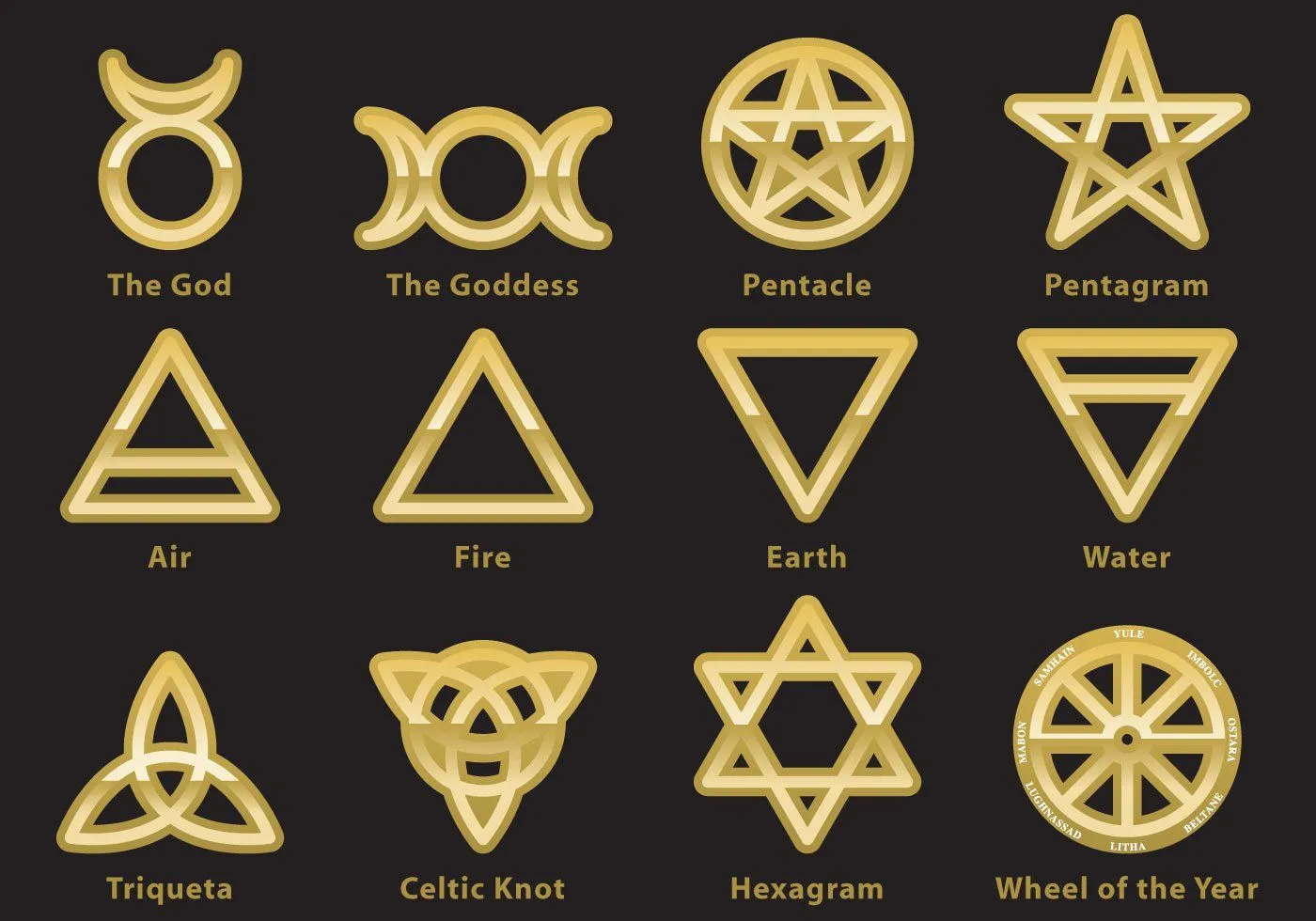
The Pentagram
The pentagram as a “Satanic” symbol was largely cemented by Anton LaVey’s Church of Satan in 1966, when he deliberately inverted it and placed it on their materials as provocation. Before that, the inverted pentagram had associations with the second degree in certain Masonic and Wiccan traditions. Not evil. Just directional.
The upright pentagram appears in medieval Arthurian texts as a symbol of Sir Gawain’s virtue. Heinrich Cornelius Agrippa used it in Three Books of Occult Philosophy (1531) as a symbol of the human microcosm, five points for the five senses, five limbs. Protective, not demonic.
I’ve shown people the Agrippa text directly when they were scared of pentagrams in my space. Every single time, the fear dropped immediately. That’s the full origin. That’s the whole story.

The Main Magic Symbols and What They Actually Do
The Pentagram and Inverted Pentagram
The upright pentagram points up toward spirit over matter. Used in protection circles, warding door frames, and sealing spells. The inverted pentagram points toward earth and flesh, used in grounding work and second-degree Wiccan initiation, not in cursing.

The Triquetra
The triquetra is three interlocking arcs forming a three-point knot with no beginning and no end. It appears in the Book of Kells (9th century Irish manuscript) as Christian ornamentation but predates that use in Celtic knotwork. I use it in binding work and in any working where I need continuity, something that can’t be broken or interrupted.

The Triple Moon Symbol
Waxing crescent, full moon, waning crescent flanked together. This one gets sold as “ancient” constantly but was largely popularized through 20th century Wicca. That doesn’t make it useless. What it represents is the three phases of the Goddess in Wiccan tradition, maiden, mother, crone. I use it in moon cycle workings and goddess-oriented altar setups.

The Triskelion
Three spiraling legs or arms rotating from a single center point. Found carved in Neolithic megalithic tombs at Newgrange, Ireland, dating to around 3200 BCE. It represents motion, cycle, and forward momentum. I use it in workings focused on change that can’t be reversed, situations where I need movement, not stillness.

The Eye of Hecate
A stylized eye with a vertical pupil inside a circle, sometimes flanked by crossed keys. It’s specifically associated with Hecate as goddess of the crossroads, witchcraft, and the liminal. When I draw this on a black candle, I’m signaling “open the crossroads, bring clarity.” It’s the symbol I reach for most in divination prep and before any working where I need to see clearly what’s actually happening.

The Helm of Awe (Aegishjalmur)
Eight trident-shaped arms radiating from a central point. The name translates roughly as “helm of terror” in Old Norse. It appears in the Poetic Edda, specifically in the Fafnismal where Fafnir claims to have worn it to keep enemies paralyzed with fear. When you hold a piece of paper with this drawn on it, it feels heavier than it should. That’s not mysticism. That’s your nervous system recognizing something it knows means business.
I use it for protection work and for workings where I need to project authority or hold a boundary that can’t be pushed. It belongs with the broader family of witch symbols that carry genuine pre-modern weight.

The Algiz Rune
Algiz looks like an upward-reaching Y, or a figure with arms raised. From the Elder Futhark, the oldest runic alphabet used by Germanic peoples. Its protective association is documented in runic poems, specifically the Old English Rune Poem which describes it as a type of sedge grass, sharp-edged, that cuts anyone who tries to grab it. I use it carved into candles for protection workings and scratched into salt at thresholds. The ancient witchcraft symbols with the most consistent track record in my practice are almost always Elder Futhark runes.

The Bind Rune
A bind rune is two or more runes combined into a single symbol for a specific purpose. There’s no one fixed bind rune for anything. You build it yourself based on which runes carry the qualities you need for that working. The biggest mistake I made when I first started with bind runes was using too many runes in one symbol. Three is usually the limit before it becomes visual noise with no clear purpose.

The Sigil of Lucifer
A seal attributed to Lucifer in the Grimorium Verum, an 18th-century French grimoire. It’s not a symbol of worship or evil. In grimoire tradition it functions as an address, a way to direct a working toward a specific entity. People who use it today generally work within a left-hand path or ceremonial magic framework. I don’t use it in my personal practice, but I’ve encountered it enough in historical research that it’s worth naming accurately rather than letting pop culture define it.

The Hexagram (Seal of Solomon)
Two overlaid triangles, one pointing up, one down. It appears in the Key of Solomon manuscripts as a protective and summoning seal, centuries before it became exclusively associated with Judaism in popular awareness. In ceremonial magic tradition it represents the union of opposing forces, fire and water, above and below. I use it in workings where I need to balance two competing forces rather than push one direction.

The Ankh
A cross with a looped top. Egyptian in origin, appearing in hieroglyphics as the word for “life.” It was adopted into Coptic Christian iconography and later into modern witchcraft and ceremonial magic as a symbol of life force, continuity, and protection. When you hold a metal ankh, the loop is slightly warm in your hand faster than you’d expect. If you don’t have a formal ankh pendant, don’t panic. I actually prefer a simple one from a craft store because ornate versions tend to be too heavy for candle carving.

The Ouroboros
A serpent eating its own tail. It appears in the Egyptian Enigmatic Book of the Netherworld (14th century BCE) and later in Greek alchemical manuscripts as a symbol of eternal return and self-sustaining cycles. I use it to seal workings that need to be self-reinforcing, specifically protection spells I want to maintain themselves without constant recharging.

The Eye of Providence
An eye inside a triangle with radiating lines around it. Most people associate it with Freemasonry or conspiracy theories. Its actual origin in magical practice is as an all-seeing protective eye, a ward against deception and hidden threats. I use it above doorways in protective workings and in any situation where I suspect something is being hidden from me that needs to be visible.

The Caduceus
Two serpents winding around a staff topped with wings, associated with Hermes/Mercury. In modern use it gets confused constantly with the Rod of Asclepius, which is one serpent, no wings, and is the actual medical symbol. The caduceus in magical practice is specifically Hermetic and is used in workings involving communication, travel, negotiation, and the movement of information. I use it when I need a message to land exactly right.

The Veve of Erzulie Freda
Veves are ritual symbols used in Haitian Vodou to call specific Lwa (spirits). Erzulie Freda’s veve features hearts and a mirror. I’m not a Vodou practitioner and I want to be clear about that. These symbols belong to a living religion with intact initiatory tradition. I mention them here because they appear constantly in witchcraft spaces with zero context about what they are. If they’re calling to you, find a legitimate practitioner. Don’t pull them from a Google image search.

The Witch’s Knot
Four interlocked circles forming a central diamond shape, also called the Magic Knot or Mare’s Knot. It appears in Italian folk magic, specifically in the Benandanti tradition documented by historian Carlo Ginzburg in The Night Battles (1966). Used for binding, protection, and preventing harm from entering a space. It can be drawn in one continuous line if you practice the path first. I use it carved into the wax of protective candles.

Planetary Seals (Saturn, Jupiter, Mars, Venus, Mercury, Sun, Moon)
These seven seals come from the Key of Solomon manuscripts. Each planet has a specific seal used to direct workings toward that planet’s domain. Saturn for binding and endings. Jupiter for expansion and authority. Mars for conflict and courage. Venus for love and attraction. Mercury for communication and travel. Sun for visibility and success. Moon for intuition and psychic work. After spending three years working through each planetary seal systematically, I finally figured out that most people skip Saturn entirely because it feels heavy. That’s exactly why it’s the most useful one when you need something to actually stop.

Personal Sigils
A sigil is a symbol you create yourself from a specific intention. The most common method, originating with Austin Osman Spare in the early 20th century, is to write your intention as a statement, remove repeated letters and vowels, and combine the remaining letters into a single composite shape. I spent $40 testing a dozen pre-made sigil systems so you don’t have to. None of them outperformed the ones I made myself in ten minutes with full understanding of what I was building.
These belong in the casting spells category more than the traditional symbol category, but they’re worth including here because sigil work is where most beginners actually start.

How to Actually Use These Symbols in Practice
The most common methods are carving into candles, drawing on skin, writing on paper sealed in jars, scratching into salt, or marking thresholds in oil.
When you carve a symbol into a candle, you’ll immediately notice the wax curls up in thin pale ribbons and smells faintly waxy-sweet, almost like a crayon left in a hot car. That smell is now part of my working muscle memory. Every time I catch it, I shift into focus automatically.
If you don’t have a consecrated ritual pen or special ink, don’t panic. I actually prefer a standard ballpoint pen because the pressure of writing with it is more physical and grounded than a brush, and that presence matters more to me than what the ink is made of.
For skin work, draw the symbol on skin and you’ll feel a slight drag and warmth under the pen, especially if you’ve built a relationship with that symbol long enough that your body already knows what’s coming.
The profound shadow symbol work and darker seal work both benefit from understanding what you’re actually calling before you draw it. That’s practical advice, not a warning. Context is the mechanism.

When It Doesn’t Work (And Why)
I ruined my first serious warding working by layering five symbols from five different traditions on the same door frame. I thought more coverage meant more protection. What I got was a threshold that felt like static, buzzing and unfocused, slightly aggressive to everyone who crossed it including me.
I stripped it all down and started over with a single Algiz rune. That worked immediately.
The most common failure after that is using a symbol without knowing its actual function. Just because it looks powerful doesn’t mean it does what you need. A Saturn seal used when you need Jupiter energy will actively work against you.
Symbols also need maintenance. Carved candle symbols burn away. Drawn threshold marks fade. Ink on paper gets damp and soft. Part of the work is refreshing what you’ve set up. Ignore that and the whole system quietly goes dark.
For deeper context on how symbols feed into ritual structure, the dark ritual framework is worth understanding before you work with heavier seals.
Questions I Actually Get Asked About Magic Symbols
Can I combine symbols from different traditions?
You can, but it creates friction more often than power. I’ve done this in 3am in my bathroom in an emergency and it still worked because the intention was clear and urgent, but under normal conditions I keep traditions separate. Different internal logic means different directional pull.
Do I need to draw them perfectly?
The geometry needs to be recognizable. A pentagram that looks like a lumpy star isn’t a pentagram anymore. But I’ve done this in a parking lot, finger dipped in coffee on the hood of my car, and it still worked because my mind knew exactly what I was doing and why.
A student asked me once why some symbols feel heavier than others immediately on first use. What’s happening there?
The honest answer is cultural and psychological saturation. Symbols that have been used by large numbers of people for long periods of time carry a kind of weight in the collective awareness. A bind rune you invented yesterday doesn’t have that yet. It will, eventually, with your own consistent use.
Where should a beginner start?
Pick one symbol. Use it for one specific purpose. Use it twenty times before you add another. The pagan love symbols and healing symbols are both good starting points because their purpose is clear and their tradition is well documented.

A Note on Dark Magic Symbols
I get asked about dark magic symbols, curses, and baneful seals constantly. The reality? They aren’t toys, and they don’t work like they do in the movies. The biggest mistake I made early on was thinking a heavy, destructive seal would just make my working more powerful. What it actually did was make my space feel like chaotic, aggressive static for a week.
If you are going to use them, you need to understand the exact entity or energy you are directing, and you need to be prepared to physically hold that boundary. Otherwise, that energy bleeds right back into your own environment. I don’t use baneful symbols to be edgy; I use them like a crowbar when a door absolutely will not open any other way.

Where to Go From Here
Start with one tradition. Learn it until the symbols live in your hands, not just your head. That one rule would have saved me two years of scattered practice.
The circe goddess symbol is worth studying if transformation work is where you’re headed. Circe’s symbolism goes much deeper than the surface mythology suggests and connects directly to several of the symbols listed here.
If you want to keep going, the full breakdown of ancient witchcraft symbols covers the pre-modern roots in more depth than I could fit here.

My newsletter covers the working notes I don’t put on the blog, which symbols I’m actually using week to week and what results look like in real practice. No pitch. Just the actual work.
Practitioner’s Note: This post reflects 15 years of personal practice and historical research into grimoire traditions, folk magic, and Wiccan symbol systems. Magic is intention and energy work and not a substitute for medical, legal, or financial advice.


The information shared is of top quality which has to get appreciated at all levels. Well done…
Nice i really enjoyed reading your blogs. Keep on posting. Thanks
The information shared is of top quality which has to get appreciated at all levels. Well done…
A great post without any doubt.
Nice i really enjoyed reading your blogs. Keep on posting. Thanks
A great post without any doubt.
Nice i really enjoyed reading your blogs. Keep on posting. Thanks
The information shared is of top quality which has to get appreciated at all levels. Well done…
Nice i really enjoyed reading your blogs. Keep on posting. Thanks
The information shared is of top quality which has to get appreciated at all levels. Well done…
Nice i really enjoyed reading your blogs. Keep on posting. Thanks
A great post without any doubt.
Nice i really enjoyed reading your blogs. Keep on posting. Thanks
Thank you for sharing indeed great article about magic symbols !
I?ve read a few excellent stuff here. Certainly value bookmarking for revisiting. I surprise how much effort you put to make this type of excellent informative about magic symbols .
Thank you so much for sharing this wonderful post with us.
i like this magic symbols Thank you so much for sharing this wonderful post.
I cannot thank you enough for the blog article.Really thank you! Fantastic.
magic sumbols !!!! F*ckin? amazing things here. I?m very glad to see your post. Thanks a lot and i’m looking forward to contact you. Will you please drop me a e-mail?
Rocket Pool’s Ethereum staking service reaches $1B in TVL
i really love magic symbols and i have many
i want to know from where u get all the symbols and if there is any book to read about that
magic symbols have many meanings, but thank u for the harad work to explain each one
thank u for this guide it really help me
that is really nice i enjoyed reading
that is a really good guide for magic thank u
thank u so much i really needed this
누누티비
How to Swap Tokens on magic symbols: A Complete Guide 2025
thank u for all the information
can u please explain more the maagic symbols !
Never realized how seamless the magaic and spells canat work eaaasy for anayone !
Honestly, cBridge is all I use now
that is so smart thank u so much
i never think aboutt maagic or spells before
That was quick, thanks witchcraft!
Dead indited content, thanks for information .
You have brought up a very great points, thankyou for the post.
Pingback: 7 Powerful Secrets of the Sigil Witch - Witch symbols
Pingback: 10 Ancient Witchcraft Symbols Every Modern Witch Should Know - Witch symbols
Pingback: The Power of Paganism Spells: A Beginner’s Guide - Witch symbols
Pingback: A Deep Dive into Satanic Symbols and Their Meanings - Witch symbols