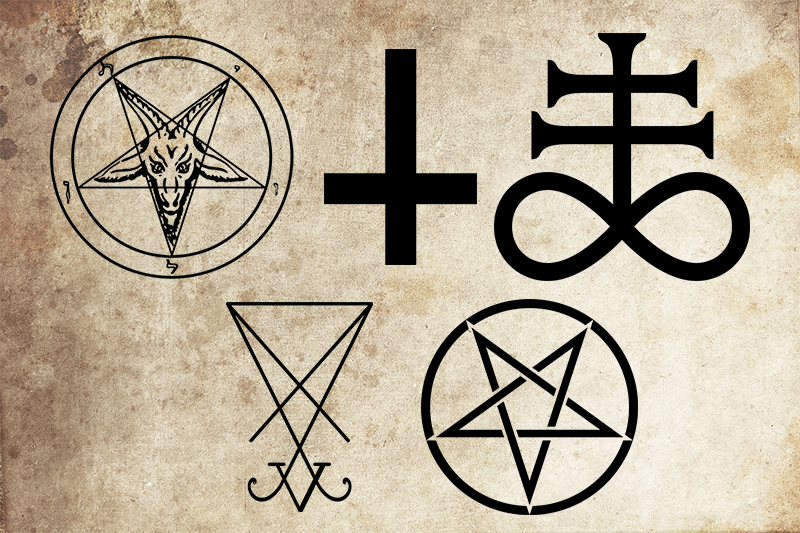
I’ve come to think of satanic symbols as falling into two distinct categories. The first covers symbols that were actually created by Satanist organisations primarily the Church of Satan and The Satanic Temple as formal emblems of their belief systems. The second is a much larger and messier category, and honestly the more interesting one: symbols that popular culture simply decided were satanic, often with no real connection to actual Satanism at all.”
Satanism itself is not a single religion. Modern Satanism broadly splits into two camps. Atheistic Satanism, best represented by LaVeyan Satanism and the Church of Satan, treats Satan as a literary and philosophical symbol rather than a literal being. Theistic Satanism involves actual worship of Satan as a deity. Most of the formal satanic iconography you will find online comes from the atheistic tradition.
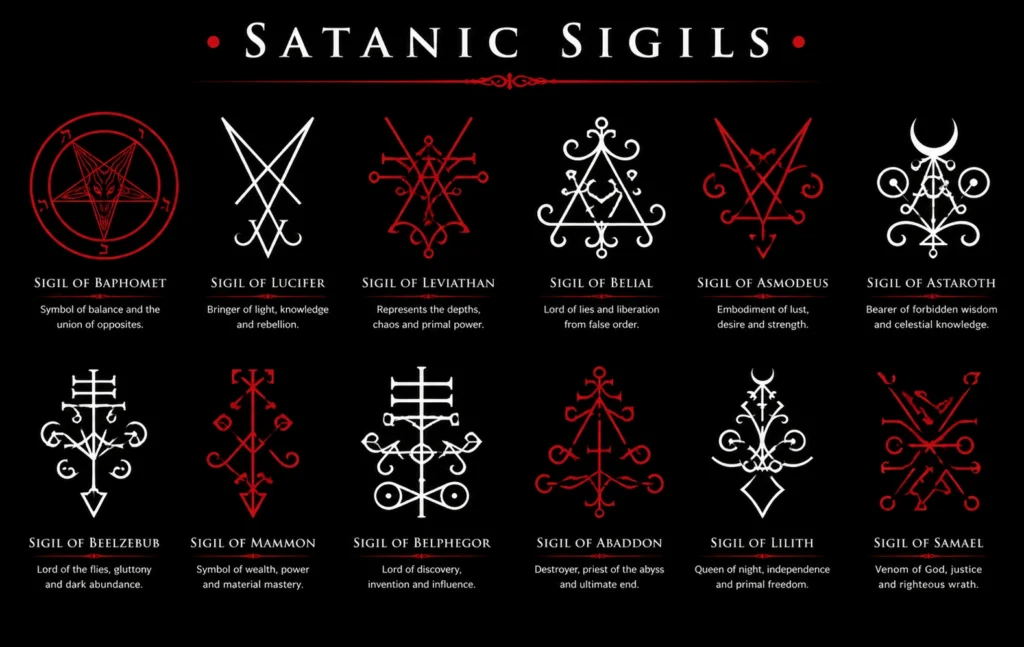
For me who study and know about all this symbols I can tell you that: Understanding that distinction matters when you look at satanic symbols, because a symbol like the Sigil of Baphomet means something very specific within LaVeyan Satanism, while in theistic satanic practice, different imagery and sigils are used. Throughout this guide, I will be clear about which tradition each symbol belongs to.
A note on sources
The primary sources for this guide are Anton LaVey’s The Satanic Bible (1969), The Satanic Temple’s official publications, and academic works on occult history including Richard Cavendish’s The Black Arts and the archaeological and theological scholarship on biblical symbolism. Where a symbol has disputed origins, this is noted.
The Sigil of Baphomet
Also called: The Goat of Mendes, The Sabbatic Goat Symbol, Church of Satan Symbol I actually love this one.
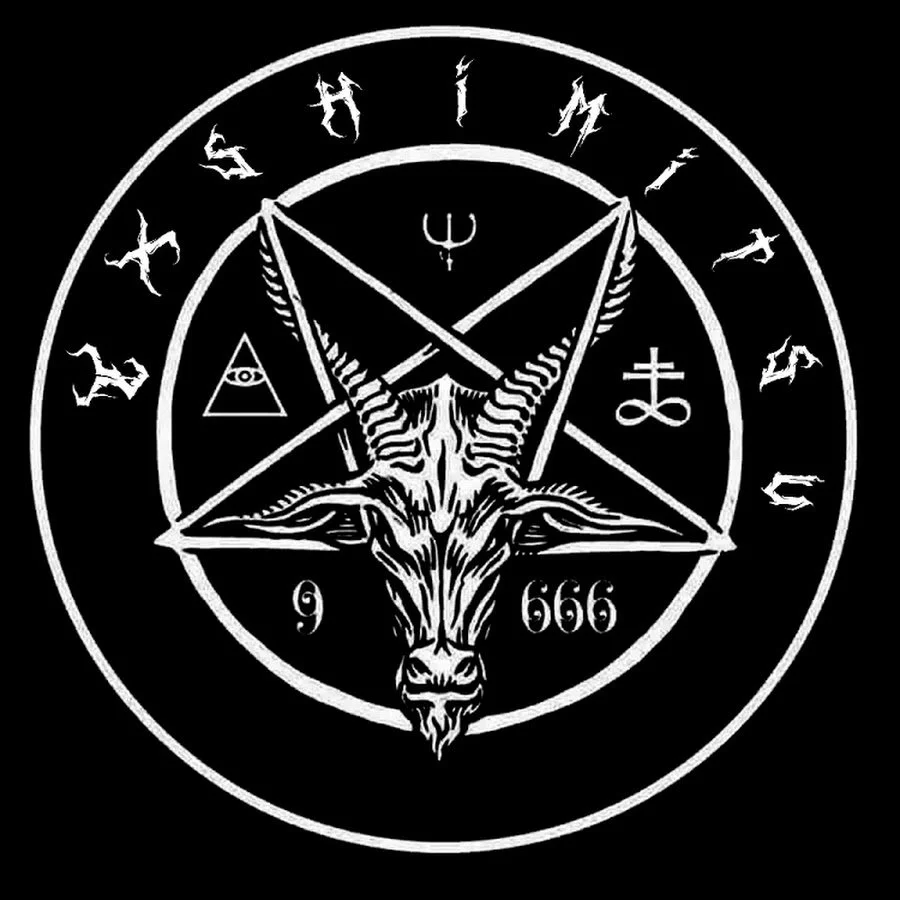
The official symbol of the Church of Satan. An inverted pentagram containing a goat’s head, surrounded by a circle inscribed with Hebrew letters spelling Leviathan. Created in its modern form by Anton LaVey in 1966.
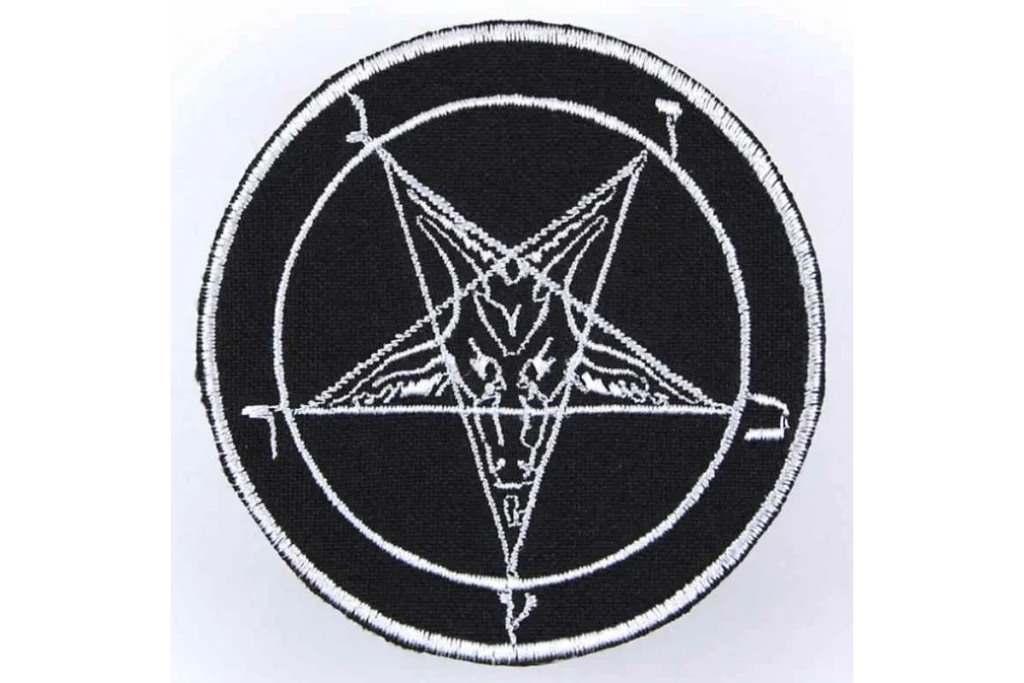
The Sigil of Baphomet is the most widely recognised satanic symbol in the world. When Anton LaVey founded the Church of Satan in San Francisco on April 30, 1966, he needed an emblem. He drew on two existing sources: the image of Baphomet and the inverted pentagram.
Baphomet has a complicated history. The name first appeared in the records of the Knights Templar trials in 1307, when the French Inquisition accused the Templars of worshipping an idol called Baphomet. Most historians today believe the confessions were extracted under torture and the idol never existed. The goat-headed image that most people associate with Baphomet was created by the French occultist Eliphas Levi in 1856, in his book Transcendental Magic. He called it the Sabbatic Goat. Levi intended his drawing as a symbol of balance between opposites, not as a representation of evil.
LaVey placed Levi’s goat inside an inverted pentagram and surrounded it with the Hebrew letters Shin, Mem, Aleph, Tav, Nun, which spell out the name Leviathan when read right to left around the circle. Leviathan is a sea monster referenced in the Hebrew Bible, and LaVey assigned it as the Satanic name of the north in his ritual framework.
The completed symbol was trademarked by the Church of Satan and remains their protected emblem. It is used in Church of Satan ceremonies, publications, and as the central image of the Satanic altar.
“LaVey did not discover these symbols in the dark. He assembled them from published occult sources and gave them a new frame. Understanding that source material separates the history from the horror film.”
The Inverted Pentagram
Also called: The Satanic Star, The Goat Star, Inverted Five-Pointed Star
let me tell you about this intresting one , A five-pointed star with one point facing downward. Used in LaVeyan Satanism as a symbol of earthly pleasures taking priority over spiritual concerns. Distinct from the upright pentagram used in Wicca and paganism.
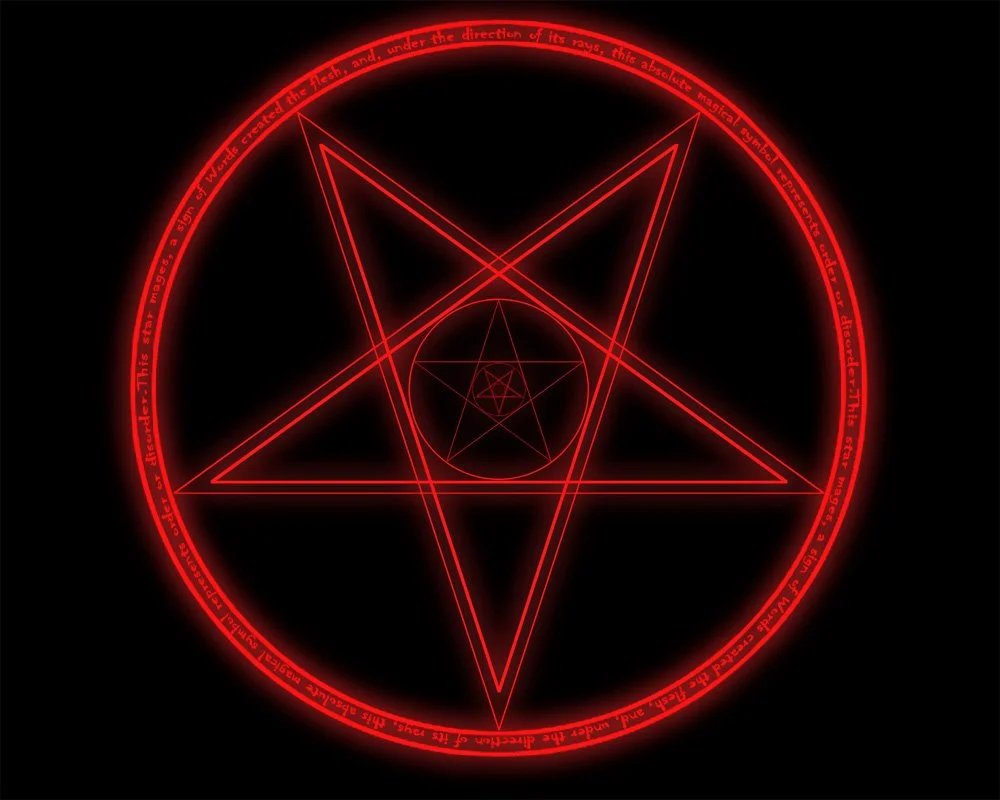
Before it became associated with Satanism, the inverted pentagram had a long history in ceremonial magic and Christian symbolism. In 13th-century Europe, a pentagram with one point downward was sometimes used to represent the two points of Christ’s humanity alongside the three points of the Trinity. The inversion carried no negative connotation.
The shift came in the 19th century. The French occultist Eliphas Levi, whose work influenced Anton LaVey significantly, argued that the upright pentagram represented the spiritual realm governing the material, while the inverted pentagram represented the opposite: matter over spirit, the physical world taking primacy. He was not calling it evil. He was making a philosophical distinction.
LaVey adopted the inverted pentagram as a central symbol of LaVeyan Satanism precisely because it expressed the philosophy of placing human, earthly experience above spiritual abstraction. The Sigil of Baphomet sits inside an inverted pentagram for exactly this reason.
One distinction I think is genuinely worth making is between the inverted pentagram and the upright pentagram used in Wicca.. The upright five-pointed star has been a symbol of protection and the five elements in Western occultism and Wiccan symbolism since long before Satanism existed. The two symbols are visually similar but represent entirely different traditions. For a full breakdown of pentagram symbolism see our guide to the pentacle symbol.
The Leviathan Cross
Also called: Cross of Satan, Sulfur Symbol, Brimstone Symbol
A double-barred cross with an infinity symbol at its base. Originally an alchemical notation for the element sulfur. Adopted by Anton LaVey in The Satanic Bible as a symbol of Satanism and the material world.
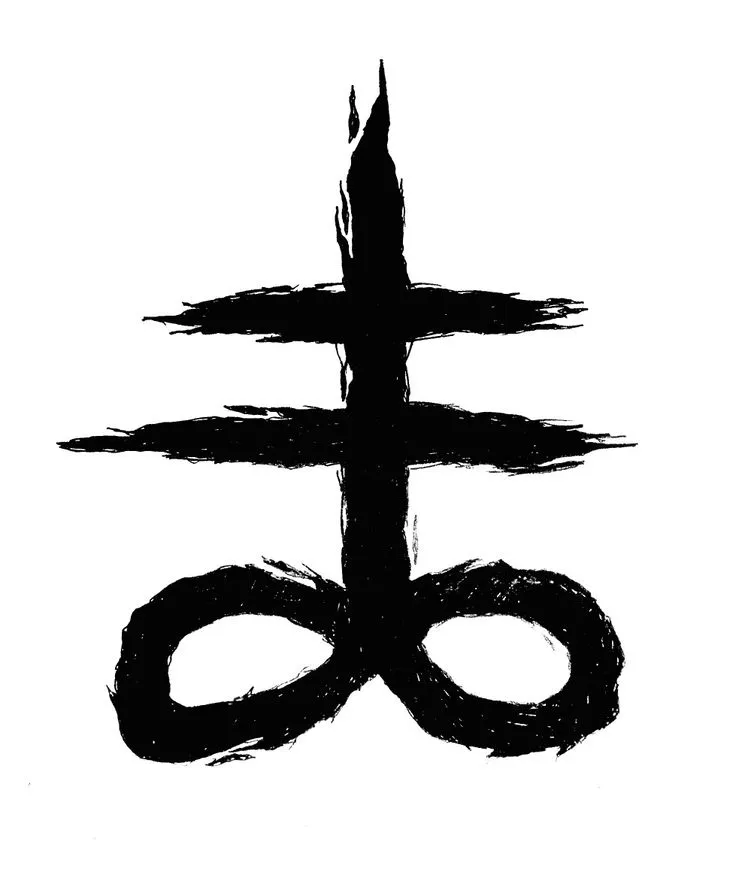
The Leviathan Cross is probably the most misunderstood satanic symbol in circulation. People see it tattooed or worn as jewellery and assume it was invented by Satanists. Its actual origin is a 17th-century chemistry textbook.
In alchemical and early chemical notation, this symbol represented the element sulfur. Sulfur was one of the three prime principles in alchemy, alongside mercury and salt, representing the soul and qualities of combustibility. The symbol appeared in dozens of scientific texts between the 1600s and 1800s as straightforward elemental notation.
Anton LaVey took the sulfur symbol and recontextualised it in The Satanic Bible (1969). He renamed it the Leviathan Cross after Leviathan, the sea monster of the Hebrew Bible that he adopted as a Satanic archetype. The infinity symbol at the base represented the eternal nature of the material world. The double crossbar he associated with balance between earthly and infernal forces.
Today the Leviathan Cross is one of the most commonly used symbols among people who identify with Satanism, particularly those who follow the LaVeyan philosophical tradition. It appears frequently in jewellery and tattoo design.
The Sigil of Lucifer
Also called: Seal of Lucifer, Luciferian Symbol
A geometric sigil composed of a downward-pointing chevron, a V shape, and a cross. Found in the Grimoirium Verum, an 18th-century grimoire. Used primarily in Luciferianism and some theistic Satanist traditions.
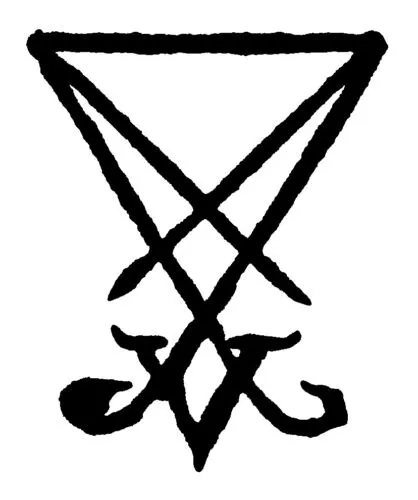
The Sigil of Lucifer comes from the Grimoirium Verum, a grimoire that first appeared in print around 1817 but claims an older origin. The grimoire contains a collection of seals and sigils attributed to various demons and infernal figures, of which Lucifer’s is among the simplest in design.
The symbol itself is a compact geometric shape. At the top, two lines meet in a downward V. Below that, an X or cross shape. At the base, another V pointing down. This type of sigil design, where a spirit’s name is compressed into geometric notation, was standard practice in grimoire magic and has nothing specifically Christian or anti-Christian about its method. The same technique was used for angelic sigils.
The Sigil of Lucifer is used primarily in Luciferianism, which should be distinguished from LaVeyan Satanism. Luciferians typically treat Lucifer as a symbol of enlightenment, knowledge, and individual freedom rather than as a figure of evil or rebellion. The name Lucifer means “light-bearer” in Latin, and that etymology is central to the Luciferian philosophy. Luciferian symbolism draws more heavily on Gnostic, Hermetic, and grimoire traditions than on the Church of Satan’s aesthetic.
The Number 666 and the Mark of the Beast
The number 666 is probably the most recognisable symbol associated with Satan or the devil in popular culture. It comes from a specific passage in the Book of Revelation, chapter 13, verse 18: “Here is wisdom. Let him that hath understanding count the number of the beast: for it is the number of a man; and his number is Six hundred threescore and six.”
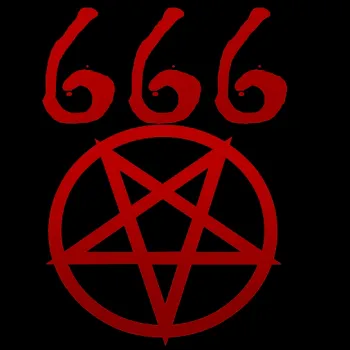
Most biblical scholars today interpret 666 through the lens of gematria, a system where letters correspond to numbers. In Greek and Hebrew, every letter has a numerical value. Most serious scholarship on Revelation points to Nero Caesar as the figure encoded in 666. When you transliterate “Nero Caesar” into Hebrew, the letters add up to 666. This interpretation is consistent with Revelation being written as a coded political text during Roman persecution of early Christians, not as a literal prophecy about the future.
The hand sign associated with 666, formed by making a circle with the thumb and forefinger while extending three fingers, is more recent. In popular culture it has been associated with Satanism, but it is also a standard American Sign Language gesture and appears in countless contexts with no satanic meaning. The specific Satanic hand signs used in formal LaVeyan ritual are different. For a full breakdown, see our guide to satanic hand signs.
The Inverted Cross
The inverted cross, a cross turned upside down, is widely assumed to be a satanic symbol. Its actual history runs in the opposite direction.
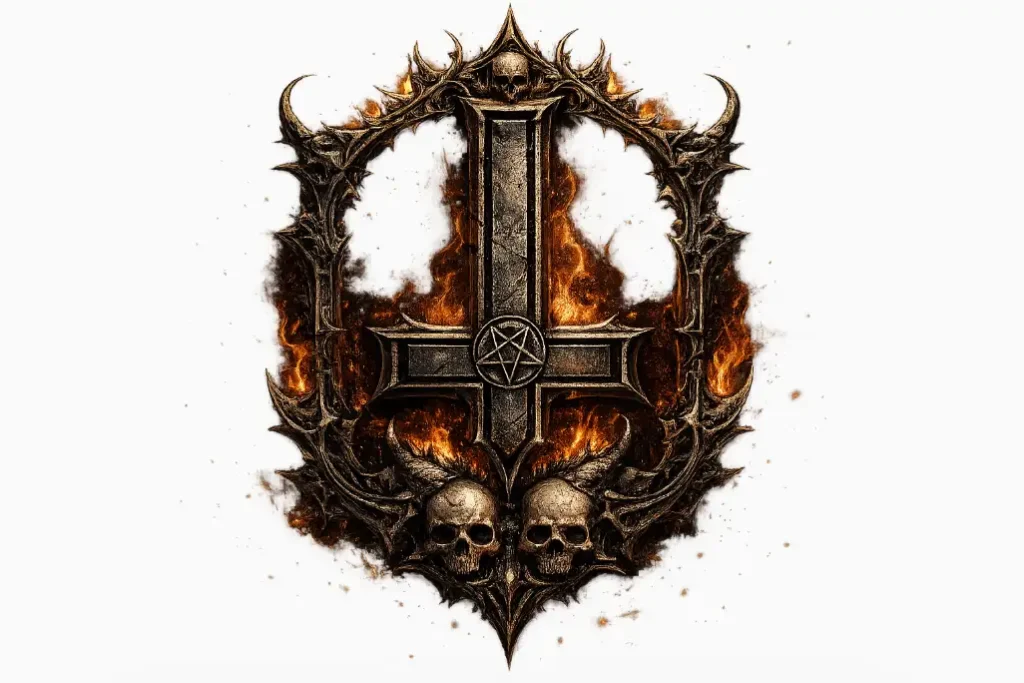
One of my favourite examples of how badly context gets lost is the inverted cross. Most people today assume it’s a satanic symbol, but its actual history is deeply Christian. According to early Christian tradition, the Apostle Peter was martyred by crucifixion in Rome around 64 CE during Nero’s persecution. Peter reportedly asked to be crucified upside down because he felt unworthy to die the same way as Jesus Christ. That act of humility is where the inverted cross comes from.
It’s not a fringe detail either. The Cross of Saint Peter appears throughout Catholic art and architecture — the papal chair in St. Peter’s Basilica has one on its back, and several popes have worn it as an emblem. It is one of the oldest symbols in Catholic iconography.
Its association with Satanism is actually a 20th century invention, driven by horror films and heavy metal imagery, where flipping Christian symbols became visual shorthand for an anti-Christian aesthetic. The association stuck in popular culture. But the symbol’s Christian origin didn’t change just because pop culture decided to redecorate it.
Read More: Irish Symbols and Their Meanings
The Black Sun
Also called: Schwarze Sonne, Sol Niger, Sunwheel
A circular symbol with twelve radial spokes or runes extending outward. Best known from a mosaic in Wewelsburg Castle built under Heinrich Himmler. Also appears in alchemical texts as Sol Niger, representing the beginning of transformation.
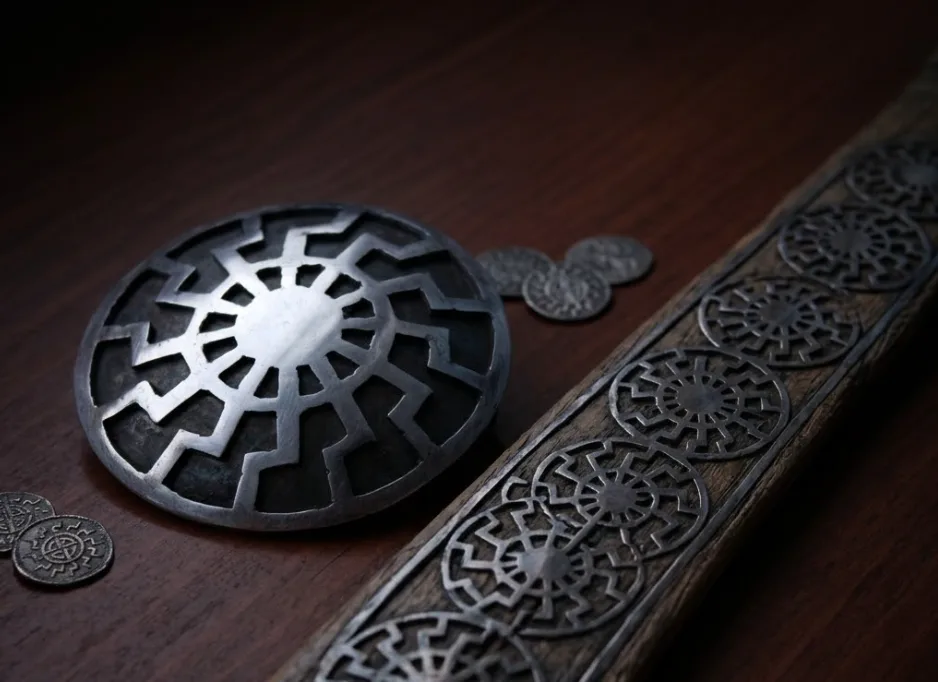
The Black Sun appears in two distinct contexts that are often confused. In alchemy, Sol Niger or the Black Sun represented the first stage of the magnum opus, the great work of transformation. It symbolised the death of the impure material before purification and renewal. In this context it had no connection to Satanism or dark spiritual forces.
The more modern version of the Black Sun symbol, a circle with twelve stylised runes as spokes, was installed as a mosaic in Wewelsburg Castle in Germany during the Nazi period under Heinrich Himmler, who used the castle as an SS headquarters. The symbol became associated with Nazi esotericism and later with neo-Nazi and far-right movements.
Today the Black Sun appears in some Satanist and LHP (Left Hand Path) esoteric traditions, where it is used as a symbol of hidden spiritual power or the shadow self. But its Nazi associations remain and represent a serious concern when the symbol appears in contemporary contexts. It should not be worn or used without understanding that history.
Satanic Sigils
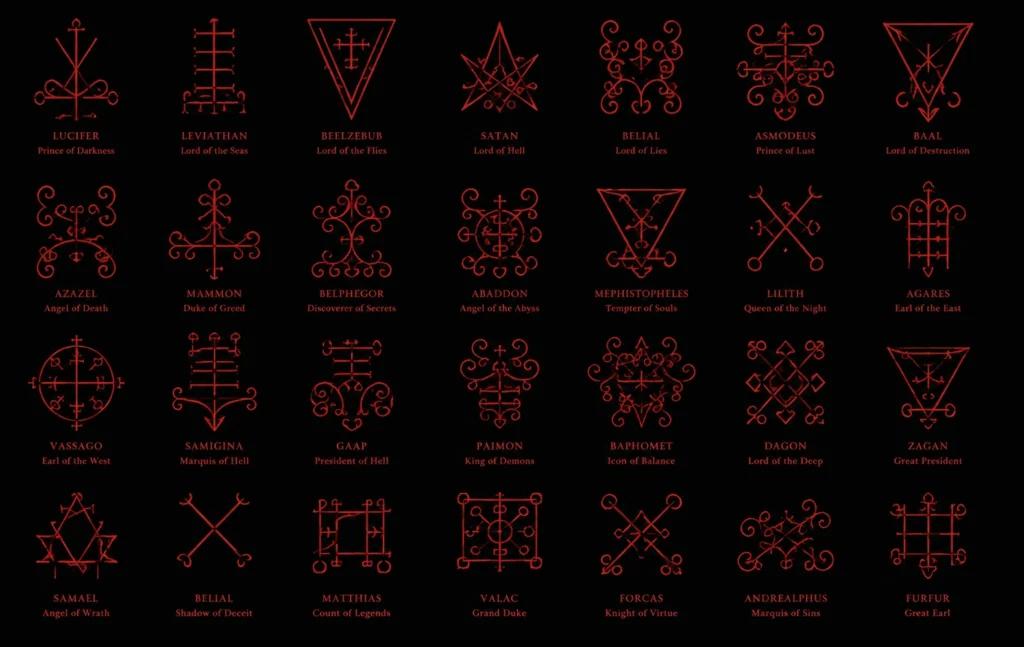
A sigil is a symbol created to represent a specific spiritual entity, intention, or force. The practice of creating sigils is ancient and appears across many magical traditions. In the context of Satanism, sigils are used in ritual to invoke or represent specific demons, infernal entities, or aspects of the self.
The most well-known collection of demonic sigils comes from the Ars Goetia, the first section of the Lesser Key of Solomon, a 17th-century grimoire. It lists 72 demons, each with a unique sigil. These sigils are created through a method of connecting letters of the demon’s name across a magical alphabet grid called a Rose Cross or similar diagram. The resulting geometric shapes are the individual demon’s signature.
Common Goetic sigils referenced in satanic contexts include those of Bael, Paimon, Asmodeus, and Leviathan. Each has a specific, documented design in the Goetic texts. For more on how sigils are created and used, the connection between sigil magic and witchcraft runs deeper than the satanic context alone.
In LaVeyan Satanism, sigils are used in the Satanic ritual as a focus for desire and will. Anton LaVey’s ritual framework, described in The Satanic Bible, uses a combination of established occult sigils and personally created symbols as a psychological and theatrical tool.
LaVeyan Satanism Symbols
LaVeyan Satanism was founded by Anton LaVey with the publication of The Satanic Bible in 1969. It is an atheistic philosophy that uses Satan as a symbol of carnality, individualism, and rejection of what LaVey saw as the herd mentality of conventional religion. The formal symbol set he developed for the Church of Satan is the most codified body of satanic iconography that exists.
The core symbols used in LaVeyan ritual include:
- The Sigil of Baphomet: The central altar symbol, placed above the altar during ritual and used as the emblem of the Church of Satan.
- The inverted pentagram: Used on ritual robes and as a general marker of satanic identity.
- The Leviathan Cross: A personal symbol worn by practitioners.
- The trapezoid: LaVey had a particular interest in the trapezoid as a shape he believed created a psychic “void” or focus point in ritual spaces. He wrote about this in The Satanic Rituals (1972).
- The chalice and sword: Standard ritual tools used in the three types of Satanic ritual LaVey defined: the sex ritual (called a attraction), the compassion ritual, and the destruction ritual.
The Satanic Temple Symbols
I want to be clear about something that confuses a lot of people — the Satanic Temple and the Church of Satan are not the same organisation. Where the Church of Satan is explicitly atheistic and apolitical, I find that the Satanic Temple is quite different. It describes itself as a non-theistic religious organisation that uses Satan as a symbol of personal autonomy and rational inquiry, and unlike the Church of Satan, it is actively political, using legal challenges to defend the separation of church and state.
The Satanic Temple’s most recognised symbol is the Baphomet of Mendes statue, a large bronze sculpture depicting a goat-headed, winged figure seated on a throne with two children looking up at it. The statue was designed in 2014 and proposed for display alongside a Ten Commandments monument at the Oklahoma State Capitol. It has since become the face of the organisation.
This statue is different from the Church of Satan’s Sigil of Baphomet. The two organisations use different imagery, hold different beliefs, and should not be treated as the same thing.
Occult Symbols vs Satanic Symbols
This is possibly the most important distinction in this entire guide, because the conflation of occult and satanic symbolism is responsible for most of the misinformation that surrounds these subjects.
Occult means hidden or secret. Occult symbolism covers an enormous territory: Hermeticism, Rosicrucianism, Freemasonry, alchemy, Kabbalah, Gnostic traditions, astrology, Tarot, and many more. None of these traditions are inherently Satanic. Many of them predate Christianity. The symbols found in these traditions, including the all-seeing eye, the square and compass, the hexagram, the caduceus, and hundreds of others, belong to their own specific traditions with their own specific histories.
Anton LaVey drew heavily from occult sources when building his symbolic vocabulary, which is why there is overlap. But borrowing does not make the source material satanic. The inverted pentagram existed in ceremonial magic long before LaVey used it. The sulfur symbol existed in alchemy before it became the Leviathan Cross.
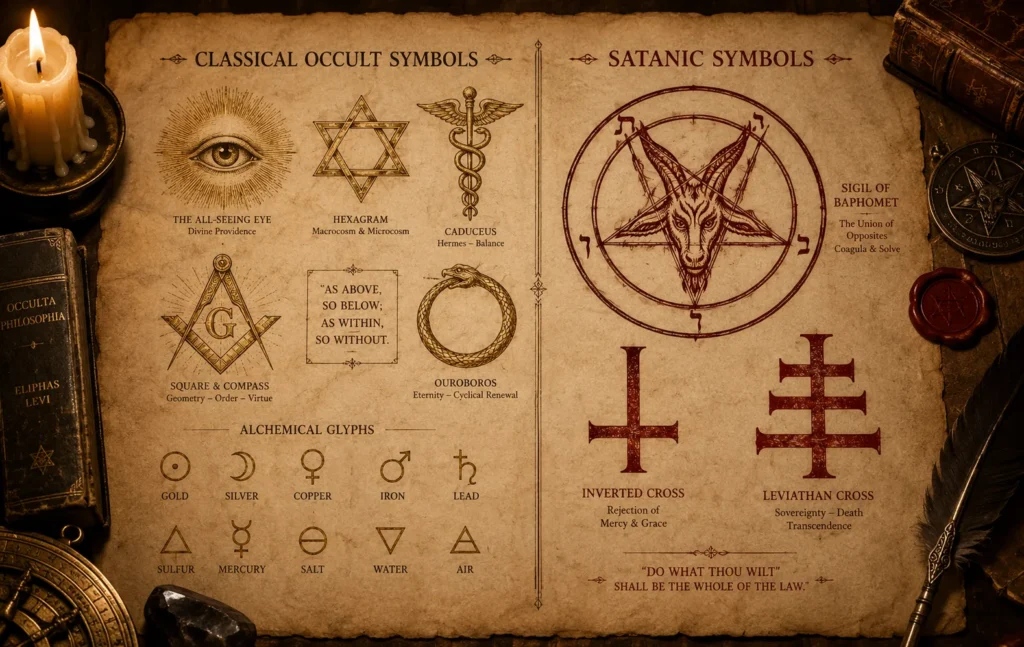
For a broader view of occult and pagan symbolism, see our guide to pagan symbols and their meanings, which covers many symbols that are frequently and incorrectly labelled as satanic.
Demonic Symbols and Their Meanings
Demonic symbols, more properly called demonic sigils, come primarily from the grimoire tradition. The major grimoires, the Lesser Key of Solomon, the Grand Grimoire, the Grimoirium Verum, and the Book of Abramelin, each contain collections of symbols attributed to specific demonic entities.
The Ars Goetia lists 72 demons with individual sigils, ranks, and descriptions of their abilities. These include well-known names like Asmodeus (described as a king associated with lust and gambling), Paimon (a king associated with knowledge and arts), Stolas (a prince associated with astronomy and herbs), and Bael (the first and most powerful king of Hell in the Goetic system, described as appearing as a cat, toad, or human).
The demonic hierarchy in these texts borrows heavily from earlier Jewish and Islamic angelology. Many of the 72 demons in the Goetia are thought by scholars to be corrupted versions of pre-Christian gods, nature spirits, and Middle Eastern deities that were reframed as demons after the spread of Christianity.
Demonic symbols are distinct from general evil symbols and their meanings. Evil symbols as a category is a popular but loose concept that groups together symbols from many different traditions that share a cultural association with dark or harmful forces.
Satanic Symbols in Everyday Life
One persistent concern online is the idea that satanic symbols are hidden inside corporate logos, government seals, and mainstream culture. This deserves a straightforward response based on what the documented history actually shows.
Several symbols that appear in everyday life do have occult origins. The all-seeing eye on the US dollar bill comes from Masonic and Hermetic tradition. The caduceus used as a medical symbol comes from Greek mythology. Certain geometric patterns used in architecture have roots in sacred geometry traditions. None of these connections make the institutions using them satanic.
Genuine satanic symbols, meaning those with documented use within Satanist organisations, are actually a small and well-defined set: the Sigil of Baphomet, the Leviathan Cross, the inverted pentagram, and the Satanic Temple’s Baphomet figure. These are not hidden. They are used openly by the organisations that created them.
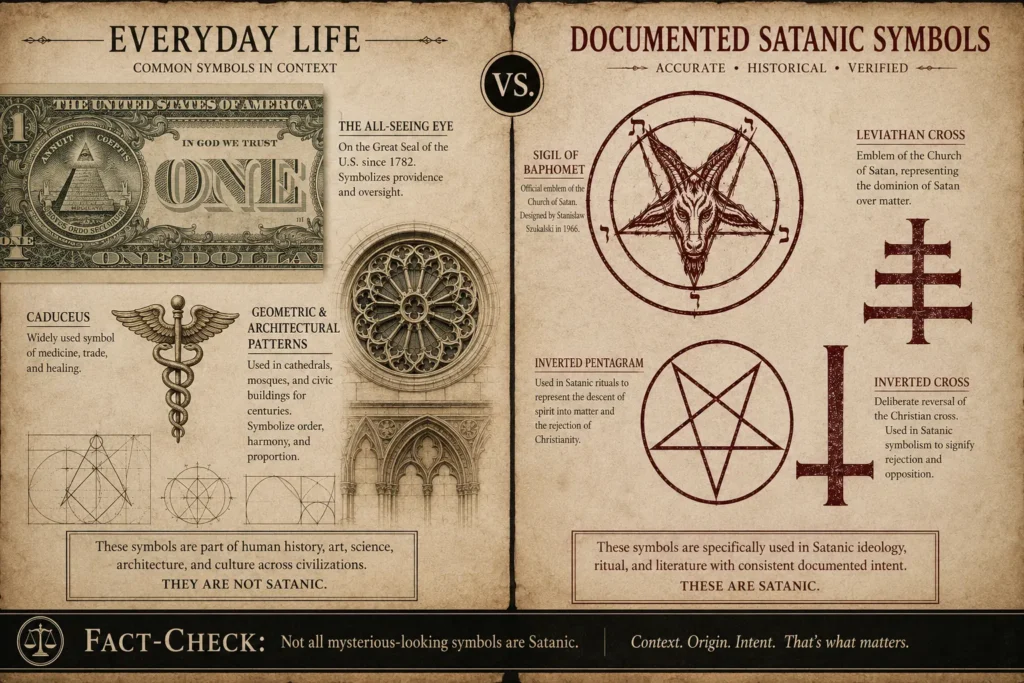
When people claim to see satanic symbols in everyday life, they are usually pattern-matching from a loose cultural association of “things that look dark or occult” rather than comparing against the documented iconography of actual satanic organisations.
Related reading
If you are researching protective symbolism as a counterpart to this topic, our guides on protection symbols for witches and ancient witchcraft symbols cover the symbols historically used for warding, defence, and spiritual protection across cultures.
Frequently asked questions
What is the most recognised satanic symbol?
The Sigil of Baphomet is the most widely recognised satanic symbol in the world. It shows an inverted pentagram with a goat’s head inside it, surrounded by a circle with Hebrew letters spelling Leviathan. Anton LaVey adopted it as the official emblem of the Church of Satan when he founded the organisation in 1966.
What is the difference between Church of Satan and The Satanic Temple symbols?
The Church of Satan, founded by Anton LaVey in 1966, uses the Sigil of Baphomet as its official symbol. The Satanic Temple, founded in 2013, uses a different image: a bronze statue of a seated goat-headed figure called the Baphomet of Mendes. They are separate organisations with different philosophies, different histories, and different iconography.
Is the inverted cross a satanic symbol?
Not originally. The inverted cross is historically known as the Cross of Saint Peter, based on the tradition that the apostle Peter asked to be crucified upside down as an act of humility. It has been a standard symbol in Catholic art and architecture for centuries and appears in St. Peter’s Basilica. Its association with Satanism is a product of 20th-century horror films and heavy metal imagery, not of documented satanic practice.
What is the Leviathan Cross?
The Leviathan Cross is a double-barred cross with an infinity symbol at the base. Before Anton LaVey adopted it in The Satanic Bible, the same symbol was used in 17th and 18th-century alchemy and chemistry as notation for the element sulfur. LaVey renamed it the Leviathan Cross and used it as a symbol of Satanism representing the eternal nature of the material world
Are occult symbols the same as satanic symbols?
No. Occult means hidden or secret knowledge and covers a vast range of traditions including alchemy, Hermeticism, Kabbalah, Freemasonry, and astrology. Satanic symbols are a small and specific subset of occult iconography. Most occult symbols have no connection to Satanism and predate the existence of organised Satanism by centuries or millennia.
What is LaVeyan Satanism?
LaVeyan Satanism is an atheistic philosophy founded by Anton LaVey in 1966 and codified in The Satanic Bible (1969). It treats Satan as a literary and philosophical symbol representing carnality, individualism, and self-determination, not as a literal deity. LaVeyan Satanists do not believe in a literal devil and do not perform rituals intended to communicate with supernatural beings
Can satanic symbols be used in public places?
The use of satanic symbols in public places is subject to local laws regarding freedom of expression and religion. It’s important to research and respect those laws before displaying symbols in public.
What do satanic symbols represent?
Satanic symbols can represent a range of concepts, including opposition to mainstream religions, personal freedom, the quest for knowledge, and the embrace of human nature in its entirety, both good and evil.
Are satanic symbols legal to display?
In many countries, the display of satanic symbols is protected under freedom of speech and religion as long as they do not incite violence or hatred.
How do people react to satanic symbols?
Reactions to satanic symbols can vary greatly. Some view them with intrigue or as a symbol of counterculture, while others may feel uncomfortable or threatened due to their association with evil and the occult.
Are satanic symbols only used by satanists?
No, satanic symbols are used by a wide range of people and groups, often outside the context of religious Satanism. They can be found in popular culture, art, and as part of personal expression.
How should one behave when using satanic symbols?
One should use satanic symbols responsibly, with an awareness of the potential impact on others, and within the bounds of local laws and regulations.
Can satanic symbols be used in public places?
The use of satanic symbols in public places is subject to local laws regarding freedom of expression and religion. It’s important to research and respect those laws before displaying symbols in public.
Final Thoughts
I always tell people that Satanic symbols carry deep historical and symbolic significance within various Satanic traditions, and that they challenge mainstream perceptions in ways most people never stop to consider. In my experience, understanding these symbols properly requires cultural and historical context, along with a genuine appreciation for the diverse interpretations and meanings people have ascribed to them over time.By exploring the origins and symbolism associated with Satanic Hand Signs, we can foster a greater understanding of the complex belief systems that encompass this mystical and often misunderstood practice.
Pingback: The Mysterious World of Hexes and Curses: A Deep Dive into Dark Magic - Witch symbols
Pingback: Evil symbols and their meanings with pictures - Witch symbols